
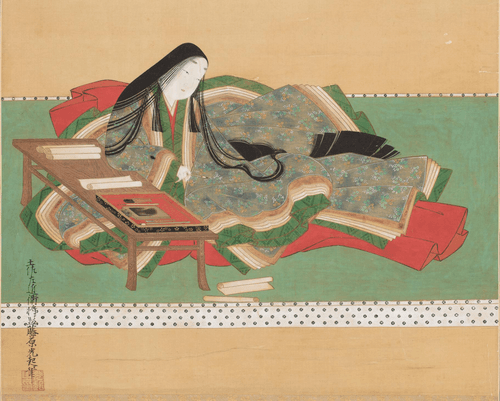
Author
Murasaki Shikibu
- Lived
- Lived 978 CE to 1014
- From
- From Japanese
- Born in
- Born in Kyoto, Japan
Born around 973 in Heian-kyō (present-day Kyoto), Murasaki Shikibu was a member of the Fujiwara clan, a daughter of the provincial governor and scholar Fujiwara no Tametoki. Her personal name is unknown , “Murasaki Shikibu” is a court sobriquet, likely derived from the name of a character in her novel and her father’s rank in the Bureau of Ceremonial. Heian women were traditionally excluded from learning Chinese, the written language of government and serious scholarship, but Murasaki, raised in her erudite father’s household, showed such precocious aptitude for the Chinese classics that her father reportedly lamented she had not been born a boy. She married Fujiwara no Nobutaka around 999 and bore a daughter, Daini no Sanmi, but her husband died after only two years of marriage. Sometime around 1005, she entered the service of Empress Shōshi at the imperial court, where the refined world of ceremonies, rivalries, love affairs, and aesthetic obsession furnished the material for her masterwork. The Tale of Genji (Genji monogatari), composed in Japanese between approximately 1000 and 1012, is widely considered the world’s first novel , a sprawling narrative of over a thousand pages following the life and loves of the radiant Prince Genji and, in its final chapters, the darker generation that succeeds him. Its psychological depth, structural sophistication, and prose of luminous beauty , deployed a full six centuries before the European novel emerged , make it one of the supreme achievements in world literature. She also kept a diary (Murasaki Shikibu nikki) and composed a collection of poetry. The date and circumstances of her death are uncertain, with scholarly estimates ranging from around 1014 to as late as 1025.
When Emperor Ichijo heard The Tale of Genji read aloud, he remarked that its author must have read the Chronicles of Japan. The lady-in-waiting Saemon no Naishi spread the word mockingly, nicknaming her Our Lady of the Chronicles. Murasaki, stung, hid her learning; yet in stolen moments she was secretly teaching Empress Shoshi the Chinese poems of Bai Juyi.
The first button needs the app on this device; the second gets it there.
In the canon
- The Tale of Genji1010
- The Diary of Lady Murasaki1010