
Author
Nathaniel Hawthorne
- Lived
- Lived 1804 to 1864
- From
- From American
- Born in
- Born in Salem, Massachusetts
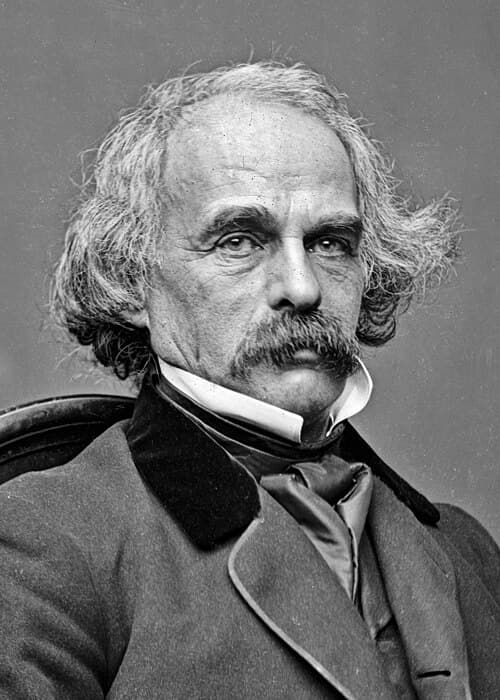
Born on July 4, 1804, in Salem, Massachusetts, Nathaniel Hathorne (he added the "w" to his surname as a young man, perhaps to distance himself from his ancestor John Hathorne, the unrepentant judge of the Salem witch trials) grew up in a household marked by his father’s early death at sea when the boy was four. Raised by a reclusive, widowed mother, he was educated at Bowdoin College in Maine, where his classmates included Henry Wadsworth Longfellow and Franklin Pierce, the future president. After graduating in 1825, he returned to Salem and spent twelve solitary years in what he called his "dismal chamber," teaching himself to write fiction. His first novel, Fanshawe (1828), was published anonymously and at his own expense; he later tried to suppress every copy. The stories collected in Twice-Told Tales (1837) brought him modest recognition, and his marriage to Sophia Peabody in 1842 drew him briefly into the Transcendentalist orbit , he lived at the Old Manse in Concord and spent time at Brook Farm, though he remained temperamentally skeptical of utopian enthusiasm. The Scarlet Letter (1850), written in a burst of creative energy after his dismissal from the Salem Custom-House, established him as the foremost American novelist of his generation, its exploration of sin, guilt, and hidden identity in Puritan New England achieving an allegorical intensity unmatched in American fiction. The House of the Seven Gables (1851) and The Blithedale Romance (1852) followed in rapid succession. His college friend Pierce, now president, appointed him American consul in Liverpool (1853–1857). He died on May 19, 1864, in Plymouth, New Hampshire, while on a trip with Pierce, passing away in his sleep at the age of fifty-nine.
In August 1850, Hawthorne joined a hiking party up Monument Mountain in the Berkshires that included a young, largely unknown novelist, Herman Melville. A thunderstorm drove the group into a cave, where the two writers talked for hours. Melville went home transformed, and dedicated the novel he was drafting, Moby-Dick, to Hawthorne.
The first button needs the app on this device; the second gets it there.
In the canon, 22 works
- My Kinsman, Major Molineux1832
- Roger Malvin's Burial1832
- The Minister's Black Veil1836
- The White Old Maid1837
- Young Goodman Brown1837
- Wakefield1837
- The May-Pole of Merry Mount1837
- Dr. Heidegger's Experiment1837
- The Great Carbuncle1837
- Endicott and the Red Cross1837
- Sights from a Steeple1837
- The Ambitious Guest1837