
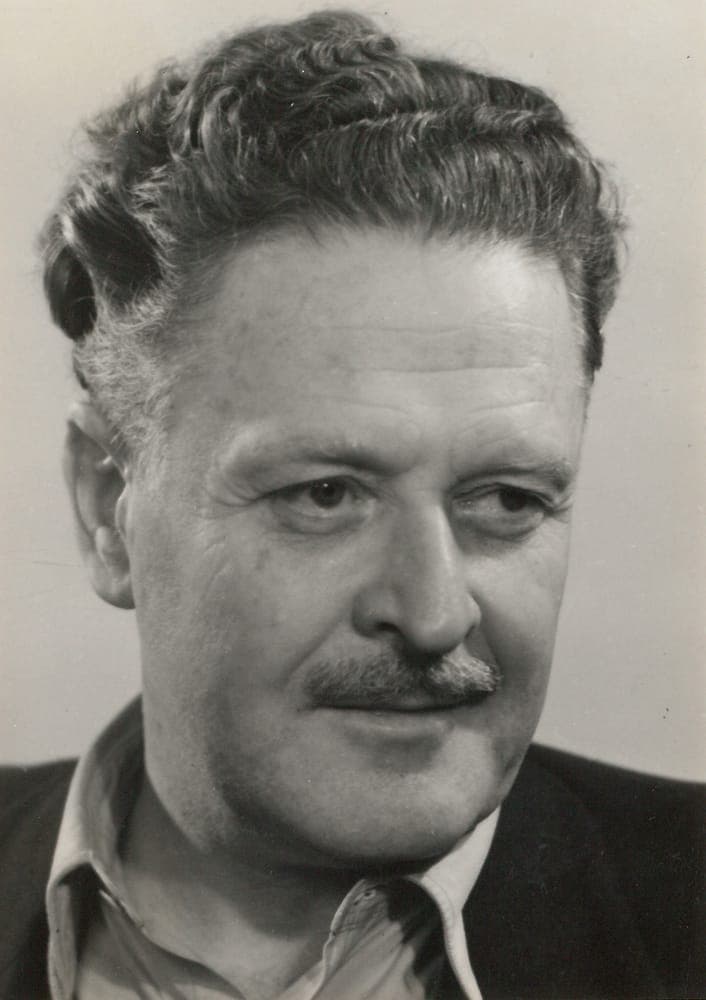
Author
Nâzim Hikmet
- Lived
- Lived 1902 to 1963
- From
- From Turkish
- Born in
- Born in Salonica, Ottoman Empire (present-day Thessaloniki, Greece)
Born Mehmed Nazim Ran on January 15, 1902, in the Ottoman port city of Salonica (now Thessaloniki, Greece), the son of a Foreign Ministry official and a painter mother, Nazim Hikmet published his first poems at seventeen and trained at the Ottoman Naval School on Heybeliada before a bout of pleurisy ended his brief service aboard the cruiser Hamidiye. In 1921, disillusioned with the pace of the war then raging in Anatolia, he crossed into Soviet Georgia and reached Moscow, where he studied economics at the Communist University of the Toilers of the East and absorbed the clangorous free verse of Vladimir Mayakovsky, breaking permanently from Ottoman syllabic form. Returning to the new Turkish Republic, he published the landmark collection 835 Satır (1929), the country's first major book of unrhymed, free-verse Turkish, and spent the next decade writing, editing, and drawing repeated short prison terms for his communism. In 1938, after naval cadets were found reading his long poem on the medieval rebel dervish Sheikh Bedreddin, a court-martial aboard a warship convicted him of inciting mutiny and sentenced him to twenty-eight years. He served twelve of them, mostly at Bursa, translating Tolstoy's War and Peace, teaching fellow prisoners to read, and drafting Human Landscapes from My Country, his sprawling verse-history of the Turkish twentieth century. A 1950 hunger strike, joined by his own mother and championed abroad by Picasso, Robeson, and Sartre, helped force the general amnesty that freed him that May; the same year the World Peace Council gave him its International Peace Prize. Fearing re-arrest, he fled by boat across the Black Sea in June 1951 and was stripped of his Turkish citizenship weeks later. In Moscow he married the Russian screenwriter Vera Tulyakova in 1960, his last marriage after his wife Piraye Altınoğlu and his common-law partner Münevver Andaç, mother of his only child, and there wrote the semi-autobiographical novel Life's Good, Brother. He died of a heart attack on June 3, 1963, in Peredelkino, and lies in Moscow's Novodevichy Cemetery; Turkey restored his citizenship in 2009, forty-six years too late.
In 1938, a naval court tried Hikmet aboard a warship, and guards locked him in a latrine where the filth rose past his knees. Pablo Neruda later wrote that Hikmet began to sing, low at first, then louder, until he was singing every love poem and peasant ballad he knew, and outlasted them.
The first button needs the app on this device; the second gets it there.
In the canon
- Life's Good, Brother1962