
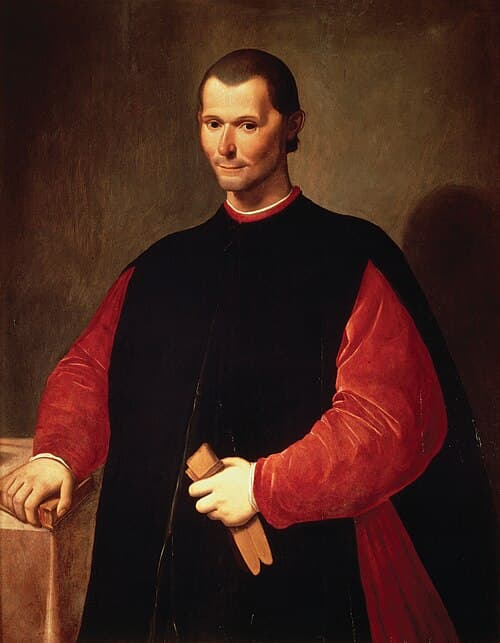
Author
Niccolò Machiavelli
- Lived
- Lived 1469 to 1527
- From
- From Italian
- Born in
- Born in Florence, Italy
Born on May 3, 1469, in Florence, during the golden age of Lorenzo de’ Medici’s rule, Niccolò di Bernardo dei Machiavelli was the son of a lawyer of modest means in a city that prized wealth and patronage. His formal education was grounded in Latin classics, and in 1498, at twenty-nine, he was appointed secretary to the Second Chancery of the Florentine Republic, a post that placed him at the center of Italian diplomacy for fourteen years. He undertook missions to the courts of France, the Holy Roman Empire, and the papal curia, and observed at close range the ruthless statecraft of Cesare Borgia, whose methods both fascinated and instructed him. When the Medici returned to power in 1512, Machiavelli was dismissed, imprisoned, and tortured on the strappado , suspended by his bound wrists until his shoulders dislocated , on suspicion of conspiracy. Released and exiled to his small farm at Sant’Andrea in Percussina, he spent his evenings, as he wrote in a famous letter to Francesco Vettori, changing out of his mud-spattered clothes into court robes to commune with the ancients and compose The Prince (Il Principe, written 1513, published posthumously in 1532), the work that made his name synonymous with political cunning. Its unflinching analysis of power , how to seize it, wield it, and keep it , shocked and disturbed readers for centuries, yet also earned him the title of father of modern political philosophy. He also wrote the Discourses on Livy (1531), the comedy Mandragola (c. 1518), and The Art of War (1521). He died on June 21, 1527, in Florence, still hoping for a political appointment that never came.
On the last day of 1502, serving as Florence's envoy at Cesare Borgia's court, Machiavelli watched the duke lure his rebellious captains to Senigallia under a show of friendship and have them strangled that night. The cold efficiency of it lodged in him, and Borgia became the model prince he would later describe.
The first button needs the app on this device; the second gets it there.
In the canon
- The Life of Castruccio Castracani1520
- The Art of War1521
- Mandragola1524
- Discourses on Livy1531
- The Prince1532
- Florentine Histories1532