
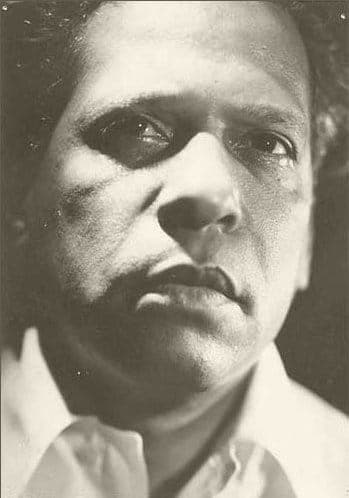
Author
Nicolás Guillén
- Lived
- Lived 1902 to 1989
- From
- From Cuban
- Born in
- Born in Camagüey, Cuba
Born on July 10, 1902, in Camagüey, Cuba, Nicolás Cristóbal Guillén Batista was the eldest of six children of Nicolás Guillén Urra, a journalist, printer and Liberal Party senator, and Argelia Batista y Arrieta. In 1917, during a political uprising, government forces killed his father and destroyed the family's printing press, where Nicolás and a brother were already working as typesetters. He studied law at the University of Havana but abandoned it, supporting himself instead as a typographer and journalist while publishing verse in Havana's magazines through the 1920s. In February 1930 a mutual friend introduced him to the American poet Langston Hughes; within months Guillén had written Motivos de son, published that April in the Diario de la Marina, a scandal and a sensation that set Afro-Cuban vernacular speech and the rhythms of the son to verse for the first time. Sóngoro cosongo followed in 1931, then West Indies Ltd. in 1934. He joined the Communist Party in 1937 and traveled that year to Spain for the Second International Writers' Congress amid the Civil War, publishing España: poema en cuatro angustias y una esperanza that same year. Barred from returning to Cuba by the Batista government after a 1953 trip to Chile, he spent six years in exile in Paris and Buenos Aires, receiving the Lenin Peace Prize in 1954 and publishing La paloma de vuelo popular in 1958. He returned to Cuba after the 1959 revolution and in 1961 was named the island's national poet and appointed founding president of the National Union of Cuban Writers and Artists, a post he held until his death. Later collections included Tengo (1964) and El gran zoo (1967). He died in Havana on July 16, 1989, six days after his eighty seventh birthday, having spent his final years in declining health from Parkinson's disease.
In February 1930, in Havana, a mutual friend introduced Guillén to the American poet Langston Hughes, then twenty seven. Guillén later said Hughes looked like any Cuban mulatto. Two months later he sent Hughes a copy of Motivos de son, inscribed to his dear friend, opening decades of correspondence and translation between the two poets.
The first button needs the app on this device; the second gets it there.
In the canon
- Sóngoro cosongo1931