
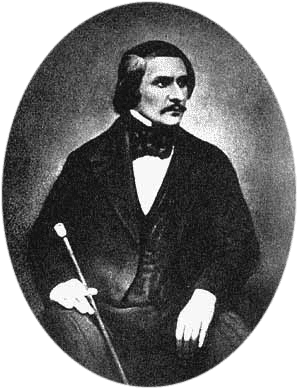
Author
Nikolai Gogol
- Lived
- Lived 1809 to 1852
- From
- From Russian
- Born in
- Born in Sorochyntsi, present-day Ukraine
Born on April 1, 1809, in Sorochyntsi, a market town in the Poltava Governorate of the Russian Empire (present-day Ukraine), Nikolai Vasilyevich Gogol grew up on his family’s modest estate amid the landscapes, folklore, and Cossack traditions of the Ukrainian countryside that would furnish the material for his earliest fiction. His father, a minor Ukrainian nobleman, wrote comedies for a local theater and died when Gogol was fifteen. After an undistinguished education at the Gymnasium of Higher Sciences in Nizhyn, he moved to St. Petersburg in 1828 with literary ambitions and an initial manuscript so poor he bought up every copy and burned them. Evenings on a Farm Near Dikanka (1831–1832), a collection of comic and supernatural tales steeped in Ukrainian folklore, won him immediate fame and the admiration of Pushkin. He followed it with the St. Petersburg tales , "The Nose" (1836), "The Overcoat" (1842), "Diary of a Madman" (1835), and "Nevsky Prospekt" (1835) , stories of such grotesque, proto-surrealist invention that Dostoevsky reportedly declared, "We all came out from Gogol’s ‘Overcoat.’" His play The Government Inspector (1836), a savage farce about corruption in a provincial town, was staged at the personal command of Tsar Nicholas I. His masterpiece, Dead Souls (1842), a picaresque novel about a swindler buying the titles to deceased serfs, was intended as the first part of a Russian Divine Comedy but was never completed. Increasingly consumed by religious mania and the influence of a fanatical priest, he burned the manuscript of the second part of Dead Souls ten days before he died on March 4, 1852, in Moscow, weakened by fasting and medieval medical treatments, at the age of forty-two.
On the night of April 19, 1836, Tsar Nicholas I sat in the imperial box at the Alexandrinsky Theatre for the premiere of The Government Inspector, Gogol's farce about officials scrambling to bribe a nobody they mistake for an inspector. The Tsar laughed hardest of all, and reportedly said everyone had got their due, himself most of all.
A ladder! Quick, a ladder!
The first button needs the app on this device; the second gets it there.
In the canon, 14 works
- Evenings On A Farm Near Dikanka1831
- Nevsky Prospekt1835
- Diary Of A Madman1835
- The Mysterious Portrait1835
- The Old World Landowners1835
- Taras Bulba1835
- Viy1835
- The Tale of How Ivan Ivanovich Quarreled with Ivan Nikiforovich1835
- The Nose1836
- The Government Inspector1836
- The Inspector General1836
- Dead Souls1842