
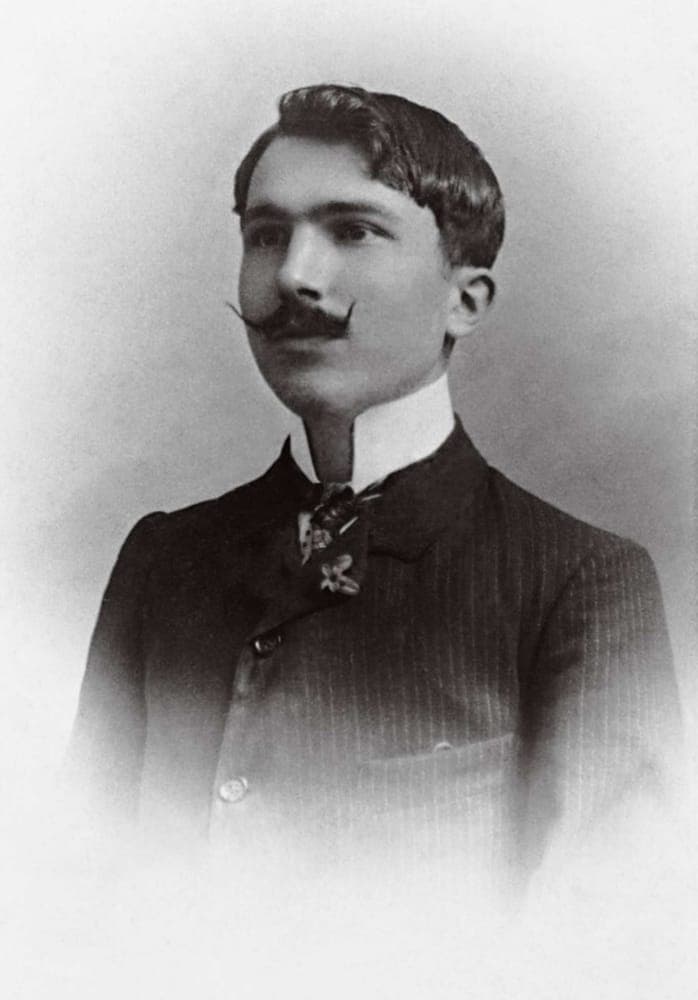
Author
Nikos Kazantzakis
- Lived
- Lived 1883 to 1957
- From
- From Greek
- Born in
- Born in Heraklion, Crete
Born on March 2, 1883, in Heraklion on Crete, then still under Ottoman rule, the son of a brooding grain merchant whose violent piety would shape every page his son ever wrote, Nikos Kazantzakis lived his childhood through the periodic Cretan revolts against the Sultan. He studied law at the University of Athens and in 1907 went to the Sorbonne to write a doctoral thesis on Nietzsche under the spell of Henri Bergson. For the next fifty years he never stopped moving, taking long sojourns in Berlin, Paris, Moscow, Mount Sinai, Cyprus, China, and Japan, translating Dante, Nietzsche, Darwin, and Homer into modern Greek along the way. His spiritual hunger was nondenominational and inexhaustible. The Saviors of God: Spiritual Exercises (1927) is his Bergsonian credo of the upward struggle of God through matter; The Odyssey: A Modern Sequel (1938) runs to thirty-three thousand seventeen-syllable lines and follows Homer's hero beyond Ithaca to the Antarctic ice. Zorba the Greek (1946) gave him a world readership, Christ Recrucified (1948) a German theatrical sensation, and The Last Temptation of Christ (1955) an excommunication threat from the Greek Orthodox Church and a place on the Vatican's Index. He was nominated for the Nobel Prize in nine separate years and lost it in 1957 to Albert Camus by a single vote; Camus said publicly that Kazantzakis deserved it a hundred times more. He died on October 26, 1957, in Freiburg im Breisgau, of leukaemia complicated by an Asian flu contracted on a final trip to China, at the age of seventy-four. He lies on the Martinengo Bastion above Heraklion under an epitaph he wrote himself: I hope for nothing. I fear nothing. I am free.
In 1917 Kazantzakis took on a lignite mine at Prastova, above the sea at Stoupa in the Mani, and put a wandering Macedonian workman named George Zorbas in charge of the men. The coal was poor and the venture failed. Nearly thirty years later he moved the mine to Crete and made the foreman immortal as Alexis Zorba.
The first button needs the app on this device; the second gets it there.
In the canon
- The Odyssey1938
- Zorba the Greek1946
- Christ Recrucified1948
- Freedom Or Death1953
- The Last Temptation of Christ1955