
Author
Oliver Goldsmith
- Lived
- Lived 1728 to 1774
- From
- From Anglo-Irish
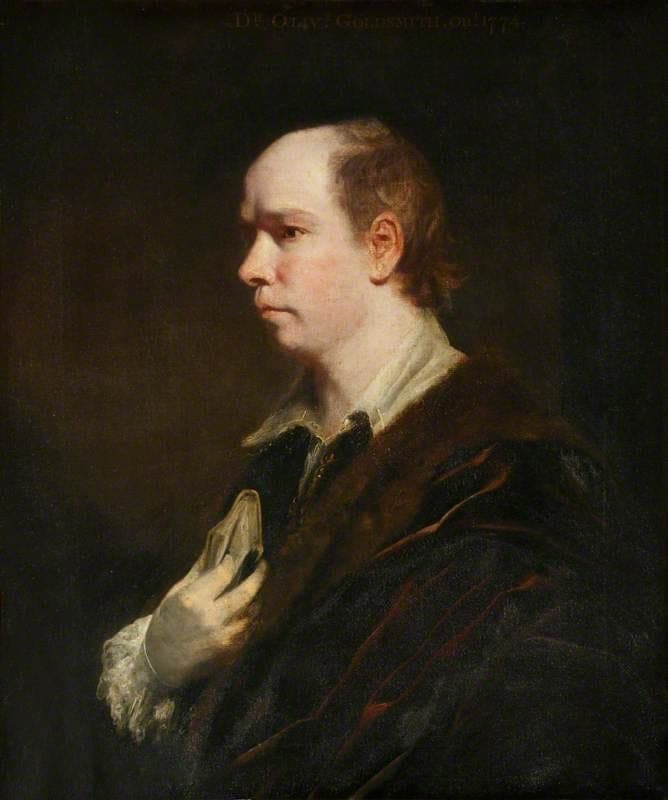
Born on November 10, 1728, somewhere on the green border of County Longford and County Roscommon in Ireland, Oliver Goldsmith was the son of an Anglican curate of modest means and a clergyman's daughter, raised in the parsonage at Lissoy. A childhood bout of smallpox left his face pitted, and the wound to his vanity never quite healed. He went up to Trinity College Dublin in 1744 as a sizar, the lowest rank of student, and was nearly expelled for joining a riot that tried to storm the Marshalsea Prison. He studied medicine desultorily at Edinburgh and Leiden, then walked through Flanders, France, Switzerland, and northern Italy on a pittance, busking on his flute. Arriving in London in 1756, he worked as an apothecary's assistant and an usher at a school before turning to the Grub Street press as a hack, perennially in debt. His painstaking essays caught the ear of Samuel Johnson, who folded him into The Club. The Vicar of Wakefield (1766), written, legend has it, to pay off a landlady who had had him arrested, sold steadily for a century. The poem The Deserted Village (1770) mourned the enclosure of the English countryside and the emigration it forced. She Stoops to Conquer (1773), staged at Covent Garden, restored laughing comedy to the English stage after a generation of sentiment. Horace Walpole called him an inspired idiot. He died in his Brick Court lodgings on April 4, 1774, at forty-five, of a kidney infection worsened by self-prescribed fever powder. Johnson wept and composed the Latin epitaph in Westminster Abbey, which credits him with touching almost every kind of writing and adorning whatever he touched.
The first button needs the app on this device; the second gets it there.
In the canon
- The Traveller1764
- The Vicar of Wakefield1766
- She Stoops to Conquer1773