
Author
Ousmane Sembène
- Lived
- Lived 1923 to 2007
- From
- From Senegalese
- Born in
- Born in Ziguinchor, Senegal
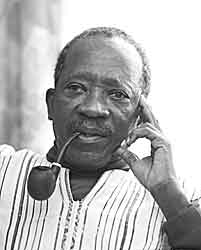
Born Ousmane Sembène on January 1, 1923, in Ziguinchor, in Senegal's southern Casamance region, the son of a fisherman, he grew up attending both a Quranic school and the local French colonial school. As a teenager he struck back against a teacher who had struck him, was expelled for good, and was sent to relatives in Dakar rather than follow his father to sea, since he was chronically seasick. He worked as an apprentice mechanic, bricklayer, and dockhand through the late 1930s, then was conscripted into the Senegalese Tirailleurs in 1944 and served with the Free French Forces through the end of the Second World War. In 1947 he took part in the Dakar-Niger railway strike, then stowed away on a ship bound for France, where he worked the docks of Marseille, joined the Communist-led CGT union, and discovered the writing of Claude McKay and Jacques Roumain. His first novel, Le Docker Noir (1956), drew on those Marseille years; his third, Les Bouts de Bois de Dieu, published in English as God's Bits of Wood (1960), turned the 1947 strike into a novel of some fifty characters spanning two countries, and remains his most acclaimed book. Believing that widespread illiteracy put his novels out of reach of most Senegalese readers, Sembène trained at Moscow's Gorky Film Studio in 1962 and 1963, then made Borom Sarret (1963), the first film shot in Africa by a Black African director, and Black Girl (1966), the first sub-Saharan African feature, which premiered at Cannes. Mandabi (1968) became the first African film in an African language, Wolof. Later films, including Xala (1975), Ceddo (1977), Camp de Thiaroye (1988), and his final work, Moolaadé (2004), continued to confront colonialism, corruption, and the treatment of African women. Sembène fell ill in December 2006 and died at home in Dakar on June 9, 2007, at eighty-four.
As a teenager in Ziguinchor, a French teacher struck him in class. Sembène struck back, and was expelled from school for good. He never returned to a classroom, working afterward as a fisherman, bricklayer, and mechanic in Dakar, and teaching himself to read from whatever fell into his hands.
The first button needs the app on this device; the second gets it there.
In the canon
- God's Bits of Wood1960