
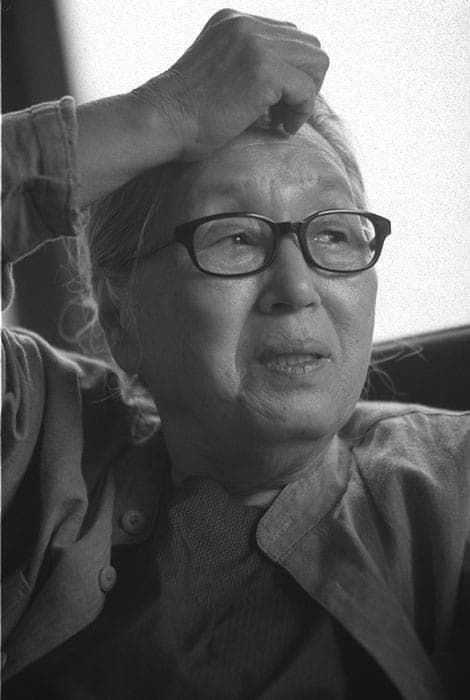
Author
Pak Kyongni
- Lived
- Lived 1926 to 2008
- From
- From Korean
- Born in
- Born in Tongyeong, Korea
Pak Kyongni was born Bak Geum-i on 2 December 1926 (28 October by the lunar calendar) in Tongyeong, in Japanese-ruled Korea's South Gyeongsang Province, the eldest daughter of Park Su-yong. She graduated from Jinju Girls' High School in 1946 and married Kim Haeng-do, a clerk at the state tobacco and ginseng monopoly, that same year. The Korean War tore the marriage apart: Kim disappeared in the war's opening months and was later recorded as having died in custody on 25 December 1950, and Pak lost her three-year-old son not long after. Widowed and grieving, she began writing to support herself and her surviving daughter, Kim Young-ju, publishing her first story, 'Gyesan' (Calculations), in 1955 under a pen name the novelist Kim Tong-ni had assigned her without asking. Novels and stories followed through the 1950s and 1960s, most drawing on wartime loss and struggling women, including 'The Daughters of Pharmacist Kim' (1962). In September 1969 she began serializing what would become her life's work, the five-part, sixteen-volume epic 'Toji' (The Land), tracing five generations of the Choi family across half a century of Korean history, from the Donghak Peasant Revolution through Japanese colonization to liberation. She kept writing through a 1971 cancer operation, resuming the manuscript with her chest still bandaged, and completed the novel in August 1994, twenty-five years and nine changes of publisher after she had started. In 1999 she opened the Toji Cultural Center on her home grounds in Wonju to house and support younger writers. Diagnosed with lung cancer in 2007 and weakened by a stroke the following April, Pak died on 5 May 2008 at a hospital in Seoul, at eighty-two. She was posthumously awarded the Geumgwan Order of Cultural Merit, South Korea's highest honor for the arts, and in 2011 the Park Kyong-ni Prize, one of the world's richest literary awards, was founded in her name.
In August 1971, mid-serialization of Toji's first volume, Park was diagnosed with cancer and underwent surgery. Discharged after two weeks, she went home and picked the manuscript back up that same day, writing on with a bandage still wound around her chest.
The first button needs the app on this device; the second gets it there.
In the canon
- Land1969