
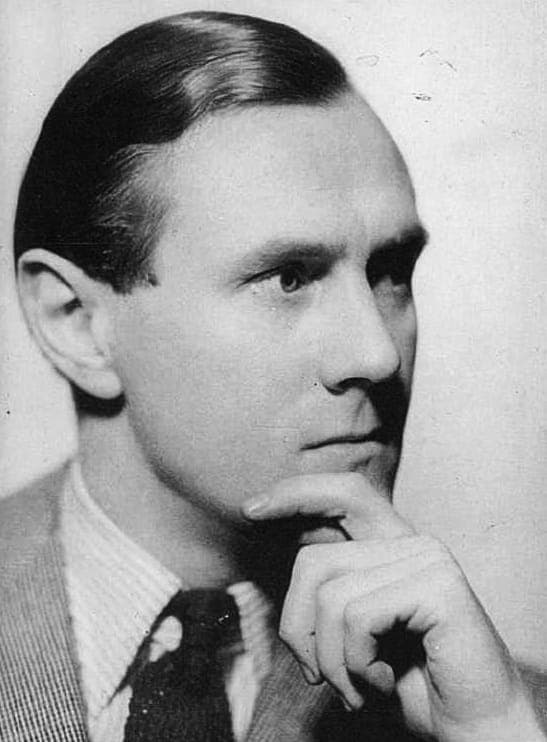
Author
Patrick White
- Lived
- Lived 1912 to 1990
- From
- From Australian
- Born in
- Born in Knightsbridge, London
Born on May 28, 1912, in Knightsbridge, London, while his wealthy grazier parents Victor and Ruth White were visiting from Australia, Patrick White was carried back to Sydney within the year and grew up amid the family's pastoral wealth, though chronic asthma dogged him from the age of four. He was sent to Cheltenham College in Gloucestershire at thirteen, a lonely colonial exile he never forgave, then worked two years on a New South Wales sheep station before reading French and German literature at King's College, Cambridge. His first novel, Happy Valley, appeared in 1939. During the Second World War he served as an RAF intelligence officer across the Middle East, and in 1941, at a party in Alexandria, met Manoly Lascaris, a Greek army recruit who became his partner for the rest of his life. The two settled in 1948 at Dogwoods, a small farm at Castle Hill outside Sydney, growing vegetables and flowers and breeding dogs while White wrote in the mornings. The Tree of Man (1955) made his name; Voss (1957), his portrait of a doomed explorer modelled on the real Ludwig Leichhardt, won the inaugural Miles Franklin Award, and Riders in the Chariot (1961) won a second. In 1973 he became the first Australian to win the Nobel Prize in Literature, cited for introducing a new continent into fiction, and refused to travel to Stockholm, sending the painter Sidney Nolan to collect it on his behalf. A Fringe of Leaves (1976) and The Twyborn Affair (1979) followed, alongside a growing reputation for prickly reclusiveness and outspoken republican politics. He resigned from the Order of Australia in 1976 in protest at the previous year's dismissal of the Whitlam government. He died at his Sydney home on September 30, 1990, at seventy eight, after refusing hospital treatment for pleurisy and a bronchial collapse brought on by his lifelong asthma, with Lascaris at his side.
In 1941, at a party in wartime Alexandria, RAF intelligence officer White met Manoly Lascaris, a Greek army recruit and fellow twenty nine year old. White called him the central mandala in his life's hitherto messy design. They stayed together for the next forty nine years, first in Cairo, then on a farm outside Sydney.
The first button needs the app on this device; the second gets it there.
In the canon
- The Living and the Dead1941
- The Tree of Man1955
- Voss1957
- Riders In The Chariot1961
- The Vivisector1970
- A Fringe Of Leaves1976