
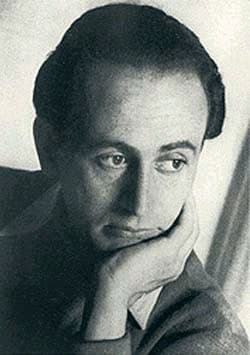
Author
Paul Celan
- Lived
- Lived 1920 to 1970
- From
- From Romanian-French
- Born in
- Born in Czernowitz, Romania (now Chernivtsi, Ukraine)
Born Paul Antschel on November 23, 1920, in Czernowitz, a multilingual city in the Bukovina region of Romania (now Chernivtsi, Ukraine), Celan grew up in a German-speaking Jewish family. His father, Leo, was a Zionist; his mother, Fritzi, instilled in him a deep love of the German language, reading him poetry and fairy tales. When the Nazis and their Romanian allies occupied Czernowitz in 1941, his parents were deported to a forced labor camp in Transnistria; his father died of typhus and his mother was shot. Celan himself survived internment in a Romanian labor camp. After the war, he moved to Bucharest, then Vienna, and finally settled in Paris in 1948, where he would live for the rest of his life. He adopted the pen name Celan, an anagram of the Romanian spelling of his surname, Ancel. His poem "Todesfuge" ("Death Fugue"), written around 1945 and published in 1948, became the most famous literary work about the Holocaust, a contrapuntal incantation built around the image of "Black milk of daybreak." He described it as a tombstone for his mother. The collections Poppy and Memory (1952), Speech-Grille (1959), and Breathturn (1967) pushed German poetry into increasingly fractured, compressed territory, language broken apart as if the very medium of his mother's murderers could not be trusted to hold meaning whole. Celan drowned himself in the Seine on or around April 20, 1970. His body was found downstream ten days later.
In July 1967 Celan, a Jew whose parents the camps had killed, climbed to the Black Forest hut of Martin Heidegger, the philosopher who had joined the Nazi Party and never publicly recanted. He signed the guestbook hoping, he wrote, for a coming word. The public reckoning never came.
The first button needs the app on this device; the second gets it there.
In the canon
- Death Fugue1948
- Stretto1959
- Psalm1963
- Threadsuns (Fadensonnen)1968