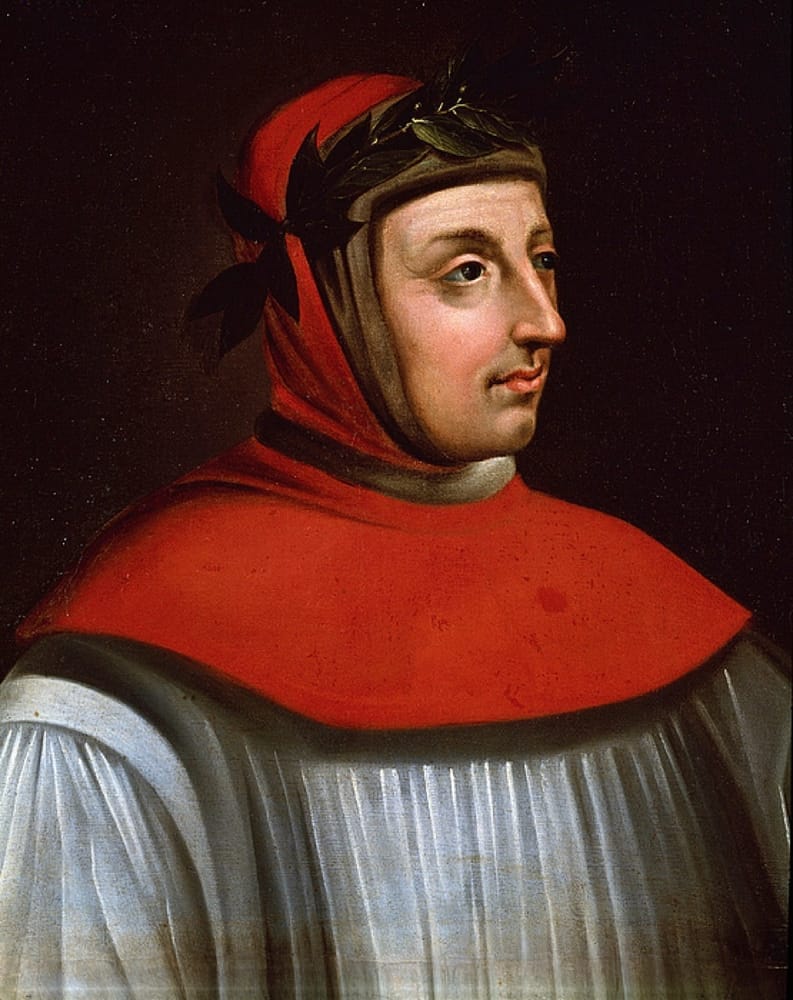
Petrarch
Italian · 1304 to 1374
Born Francesco Petrarca on July 20, 1304, in Arezzo, he was the son of a Florentine notary exiled with the same political faction that had banished Dante. The family followed the papal court to Avignon, and there, on Good Friday in 1327, in the church of Saint Clare, he glimpsed a woman he called Laura, the figure who would shadow his poetry for the rest of his life. His father sent him to study law at Montpellier and Bologna, but he abandoned it for letters after taking minor clerical orders, which freed him to read, travel, and hunt down forgotten manuscripts. In libraries across Europe he recovered lost works of Cicero, including a cache of letters found at Verona in 1345, and assembled a private collection that helped revive classical learning. He climbed Mont Ventoux in 1336 simply to see the view, an ascent often called the first recorded for its own sake. On Easter Sunday in 1341 he was crowned poet laureate on the Capitoline Hill in Rome, the first since antiquity to receive the honor. His Italian love poems, the Canzoniere, also known as Rerum vulgarium fragmenta, gathered 366 sonnets and songs around Laura and fixed the form later called the Petrarchan sonnet. He prized his Latin works more highly, among them the epic Africa, the Secretum, and the letters to ancient authors. The Triumphs, a sequence of allegorical visions, occupied his final years. Laura is thought to have died in the plague of 1348, and he grieved her in verse for decades after. He died at Arquà, near Padua, on the night of July 18, 1374, two days short of his seventieth birthday, found in his library with his head resting upon a book.