
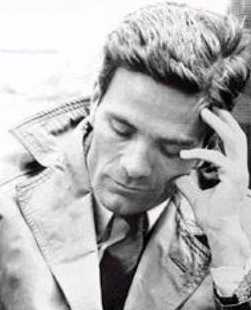
Author
Pier Paolo Pasolini
- Lived
- Lived 1922 to 1975
- From
- From Italian
Pier Paolo Pasolini was born on March 5, 1922, in Bologna, the son of an army lieutenant and a schoolteacher from Friuli, and spent an itinerant childhood following his father's postings before the family settled in his mother's home region during the war. There he wrote his first poems in Friulian dialect, published as Poesie a Casarsa in 1942, and there his younger brother Guido, a partisan, was killed by a rival communist faction in 1945, a loss that shadowed his politics for life. He joined the Italian Communist Party after the war but was expelled in 1949 following a public scandal over his homosexuality, which also cost him his teaching post and drove him, with his mother, to Rome. Poor and largely unknown, he taught school and wrote journalism while wandering the city's outlying borgate, the shantytown periphery he transformed into literature in the novels Boys Alive (1955) and A Violent Life (1959), both written in a dense Roman street slang that scandalized critics and drew an obscenity charge. From 1961 he turned increasingly to film, directing Accattone, Mamma Roma, the startlingly reverent Gospel According to St. Matthew, the Trilogy of Life adapting the Decameron, the Canterbury Tales, and the Arabian Nights, and finally the ferociously bleak Salo, or the 120 Days of Sodom, released after his death. He was also a major poet (The Ashes of Gramsci, 1957), a combative newspaper columnist, and one of the most visible Marxist intellectuals in Italy, openly gay at a time when this made him a target of prosecution and violence. On the night of November 1, 1975, he was beaten and run over with his own car on a beach near Ostia; a seventeen year old hustler was convicted of the killing, though the full circumstances remain disputed to this day.
The first button needs the app on this device; the second gets it there.
In the canon
- Boys Alive1955
- A Violent Life1959