
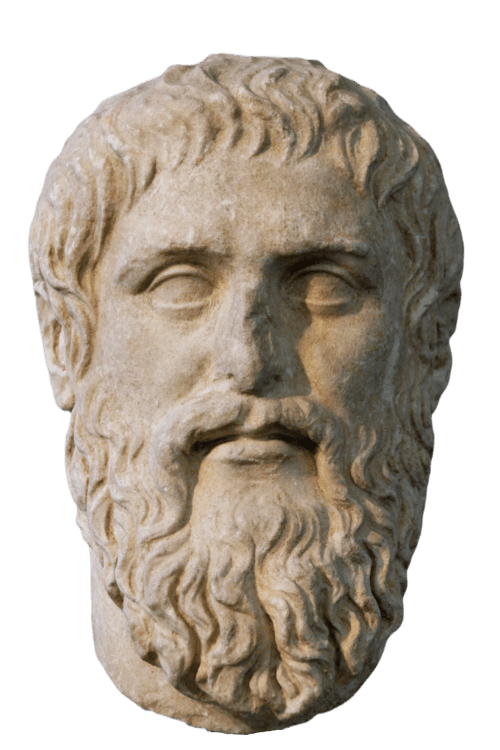
Author
Plato
- Lived
- Lived 428 BCE to 348 BCE
- From
- From Ancient Greek
- Born in
- Born in Athens, Greece
Born around 428 or 427 BC in Athens, or, by some accounts, on the island of Aegina, Plato came from one of the most distinguished families in the city, tracing his lineage on his mother's side to the great lawgiver Solon. His given name may have been Aristocles; "Plato," meaning "broad," was reportedly a nickname referring to his forehead or his wrestling physique. As a young man he was drawn to politics, but the execution of his teacher Socrates in 399 BC, condemned to drink hemlock by an Athenian jury on charges of impiety and corrupting the youth, turned him decisively toward philosophy. He traveled to southern Italy, Sicily, and Egypt before returning to Athens around 387 BC to found the Academy, often called the first institution of higher learning in the Western world, which would endure for nearly nine centuries. His surviving works, written as dialogues in which Socrates is usually the central speaker, constitute the most complete and influential body of philosophy from antiquity. The Republic envisions the ideal state governed by philosopher-kings; the Symposium explores the nature of love through a series of speeches at a drinking party; the Phaedo dramatizes Socrates' final hours. The Timaeus, the Phaedrus, the Theaetetus, each dialogue opens a different window onto questions of knowledge, beauty, justice, and the nature of reality. Alfred North Whitehead famously remarked that the European philosophical tradition "consists of a series of footnotes to Plato." He died in Athens around 348 or 347 BC, reportedly at a wedding feast, at approximately eighty years of age.
Sailing to Syracuse as a young man, Plato angered the tyrant Dionysius I with his talk of virtue and justice. Dionysius handed him to a visiting Spartan envoy with orders to sell him. Taken to Aegina and put on the block, he was recognized by a stranger, Anniceris, who paid his ransom and set him free.
The first button needs the app on this device; the second gets it there.
In the canon, 14 works
- The Apology399 BCE
- Crito399 BCE
- Early Socratic Dialogues: (Ion, Laches, Lysis, Charmides, Hippias Major, Hippias Minor, Euthydemus)390 BCE
- The Symposium385 BCE
- Meno380 BCE
- Gorgias380 BCE
- Phaedo379 BCE
- The Republic375 BCE
- Phaedrus370 BCE
- Theaetetus369 BCE
- Critias360 BCE
- Philebus360 BCE