
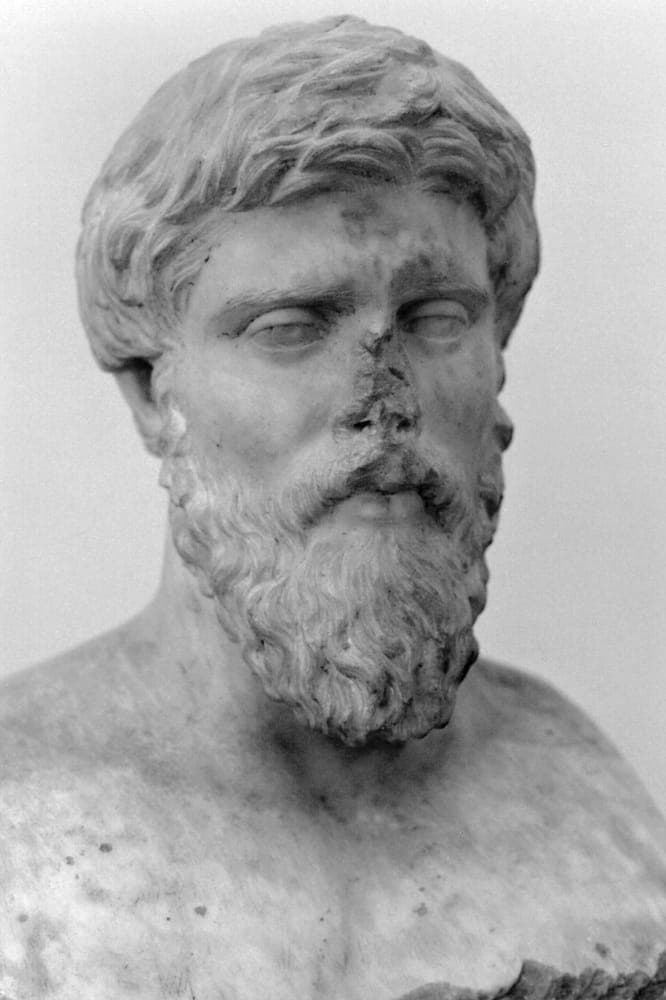
Author
Plutarch
- Lived
- Lived 46 CE to 120 CE
- From
- From Greek
- Born in
- Born in Chaeronea, Greece
Born around 46 CE in the small town of Chaeronea in Boeotia, about thirty kilometres east of Delphi, Plutarch came from a long-established Boeotian family; his father was Autobulus, his grandfather Lamprias, and his brothers Timon and Lamprias appear with affection in his dialogues. He studied mathematics and philosophy in Athens under the Platonist Ammonius around 66 to 67, attending the games at Delphi where Nero competed and possibly meeting the future emperor Vespasian. Through his Roman sponsor Lucius Mestrius Florus he received Roman citizenship and the name Lucius Mestrius Plutarchus. He lived most of his life at Chaeronea, where he served as magistrate, archon, and envoy on missions to foreign cities, and around 95 he became one of the two priests at the temple of Apollo at Delphi, helping to revive the long-declined shrine. His Parallel Lives pairs twenty-three biographies of Greeks and Romans (Alexander with Caesar, Demosthenes with Cicero, Pyrrhus with Marius) to draw out the moral character of each through what he called the small things, a jest or a passing word rather than the great battles. The Moralia gathers seventy-eight essays on subjects from the face on the moon to peace of mind, from vegetarianism to brotherly love. He and his wife Timoxena had at least four sons and a daughter; they lost the two-year-old Timoxena, named for her mother, and a son named Chaeron, and a letter to his wife counselling her not to grieve excessively survives. Late in life the emperor Hadrian appointed him nominal procurator of Achaea, entitling him to the vestments of a consul. He died in Chaeronea sometime after 119 CE, in his mid-seventies, having outlived two of his children.
Plutarch was away travelling when his two-year-old daughter Timoxena died at home. The messenger his wife sent missed him on the road to Athens, and he learned the news at Tanagra from his granddaughter. In the letter he wrote back, he remembered the child asking her nurse to feed other babies, and her toys too.
The first button needs the app on this device; the second gets it there.
In the canon
- Parallel Lives100 CE
- The Age of Alexander100 CE
- Plutarch on Sparta100 CE
- The Rise and Fall of Athens100 CE
- Consolation to His Wife100 CE
- The Fall of the Roman Republic110 CE
- Makers of Rome110 CE