
Author
Rabindranath Tagore
- Lived
- Lived 1861 to 1941
- From
- From Indian
- Born in
- Born in Calcutta, India
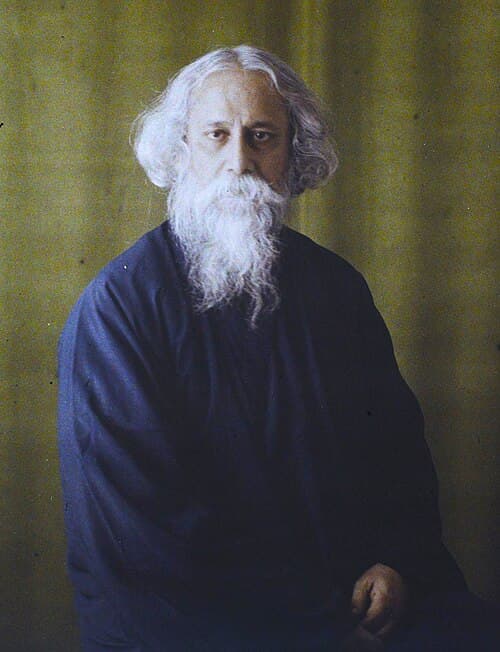
Born Rabindranath Thakur on May 7, 1861, in the Jorasanko mansion in Calcutta, the youngest of fourteen children in a wealthy and intellectually prominent Bengali Brahmin family, Tagore was immersed from childhood in a household that produced philosophers, musicians, painters, and reformers. His father, Debendranath Tagore, was a leading figure of the Brahmo Samaj reform movement. Rabindranath began writing poetry at eight and at sixteen published his first substantial poems under the pseudonym Bhanusimha ("Sun Lion"), which literary authorities briefly mistook for long-lost classics. He was sent to England in 1878 to study law at University College London but returned home without a degree, choosing instead to manage the family estates in rural Shelaidaha, where the rhythms of village life along the Padma River profoundly shaped his art. In 1913 he became the first non-European, and the first lyricist, to win the Nobel Prize in Literature, honored for the "profoundly sensitive, fresh and beautiful" English prose translations of his poetry collection Gitanjali (1912). He composed over two thousand songs, including what would become the national anthems of both India ("Jana Gana Mana") and Bangladesh ("Amar Shonar Bangla"). His novels Gora (1910) and The Home and the World (1916), his plays, essays, and paintings, and his founding of Visva-Bharati University at Santiniketan amounted to a one-man cultural renaissance. He denounced nationalism, renounced his British knighthood in 1919 after the Jallianwala Bagh massacre, and continued writing prolifically until the end. He died on August 7, 1941, in Calcutta, at eighty.
In his sixties, correcting the pages of Purabi, Tagore crossed out failed lines with such rhythm that the deletions turned into shapes: birds, flowers, imagined creatures curling across the margins. He kept going. Within a few years those doodles had become finished paintings, more than two thousand of them by his death.
The first button needs the app on this device; the second gets it there.
In the canon
- Where the Mind Is Without Fear1910
- Gora1910
- The Post Office1912
- Home and the World1916
- Red Oleanders1924
- Four Chapters1934