
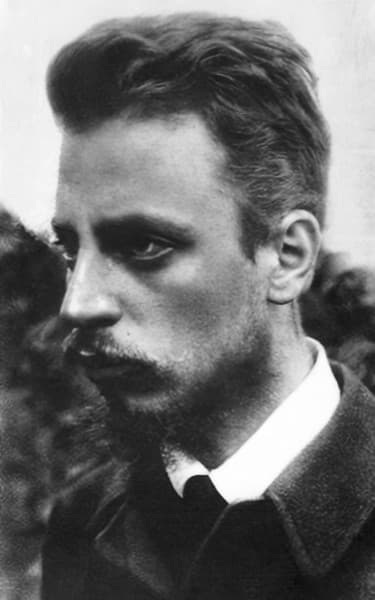
Author
Rainer Maria Rilke
- Lived
- Lived 1875 to 1926
- From
- From Austrian
- Born in
- Born in Prague, Austria-Hungary
Born Rene Karl Wilhelm Johann Josef Maria Rilke on December 4, 1875, in Prague, then part of the Austro-Hungarian Empire, Rilke endured a childhood shaped by his mother's grief over a daughter who had died before his birth. Phia Rilke dressed the boy in girl's clothing and called him Sophie until he was old enough for school. His father, a failed military officer, sent him at eleven to a military boarding school at Sankt Polten, an experience Rilke later described as one of unbroken misery. He left the school and eventually drifted toward literature, publishing his first poetry collection, Life and Songs, in 1894. In 1897, in Munich, he met Lou Andreas-Salome, the Russian-born intellectual who had been intimate with Nietzsche and would later become a psychoanalyst and friend of Freud, and she transformed him, urging him to change his first name from the feminine "Rene" to the more forceful "Rainer" and accompanying him on two journeys to Russia. From 1905 to 1906 he served as secretary to the sculptor Auguste Rodin in Paris, an apprenticeship in seeing that produced the New Poems (1907-1908) and The Notebooks of Malte Laurids Brigge (1910). In January 1912, while staying at Duino Castle on the Adriatic as a guest of Princess Marie von Thurn und Taxis, he heard, in a howling wind, the first line of what would become the Duino Elegies, a decade-long labor he completed in a "savage creative storm" in February 1922 at the Chateau de Muzot in Switzerland. He died of leukemia on December 29, 1926, in the Valmont sanatorium above Lake Geneva, at fifty-one.
In 1901 Rilke married the sculptor Clara Westhoff, and their daughter Ruth was born that December. Within months he left for Paris to write about Rodin, and the marriage settled into a lifelong separation neither could formalize: as a nominal Catholic, divorce was barred, so it simply continued at a distance for the rest of his life.
The first button needs the app on this device; the second gets it there.
In the canon, 25 works
- I live my life in widening circles1905
- I find you, Lord, in all things1905
- You, darkness, of whom I am born1905
- Put out my eyes, and I can see you still1905
- Only in our doing can we grasp you1905
- Archaic Torso of Apollo1908
- The Notebooks of Malte Laurids Brigge1910
- The Duino Elegies1923
- Sonnets to Orpheus1923
- The First Elegy1923
- The Second Elegy1923
- The Third Elegy1923