
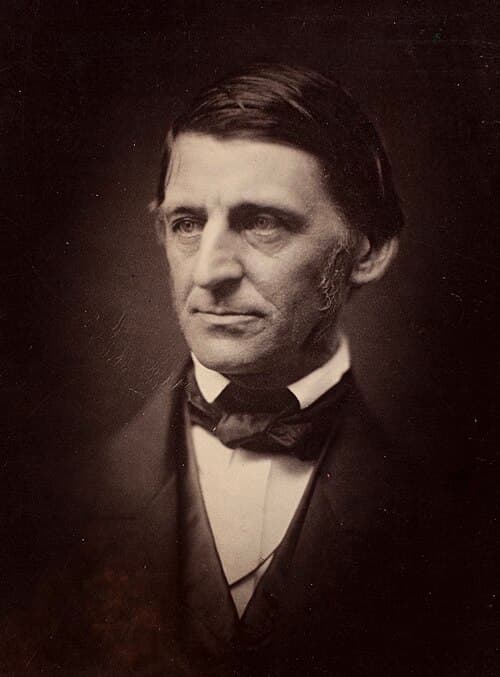
Author
Ralph Waldo Emerson
- Lived
- Lived 1803 to 1882
- From
- From American
- Born in
- Born in Boston, Massachusetts
Born on May 25, 1803, in Boston, Massachusetts, into a long line of New England ministers, Emerson was the son of William Emerson, a Unitarian pastor who died when Ralph was eight, leaving his widow, Ruth, to raise five sons in near poverty with the help of an aunt. He entered Harvard College at fourteen, graduated without particular distinction, and studied at Harvard Divinity School before being ordained as minister of Boston's Second Church in 1829. That same year he married Ellen Tucker, who died of tuberculosis in 1831, at twenty; Emerson visited her tomb almost daily and, a year after her burial, opened her coffin. The loss, combined with a growing crisis of faith, led him to resign his pastorate in 1832. He traveled to Europe, met Coleridge, Wordsworth, and Thomas Carlyle, the last becoming a lifelong correspondent, and returned to settle in Concord, Massachusetts, where he would live for the rest of his life. Nature (1836), his first major work, became the founding document of American Transcendentalism. His 1837 address "The American Scholar" was called by Oliver Wendell Holmes Sr. America's "intellectual Declaration of Independence." The essays "Self-Reliance" (1841) and "Experience" (1844) established him as the central voice of American intellectual life. Nietzsche called him "the most gifted of the Americans"; Whitman called him "master." In his later years, Emerson's memory deteriorated, possibly from what is now understood as Alzheimer's disease. He died of pneumonia on April 27, 1882, in Concord, at seventy-eight.
In January 1842, Emerson's five-year-old son Waldo died of scarlet fever after a sudden illness. Emerson wrote that he understood nothing of the loss but its bitterness. He spent the following months composing an elegy, Threnody, mourning the boy he had called the world's wonderful child.
The first button needs the app on this device; the second gets it there.
In the canon
- Nature1836
- Concord Hymn1837
- The American Scholar1837
- Self-Reliance1841
- Shakspeare; or, the Poet1850
- Fate1860