
Author
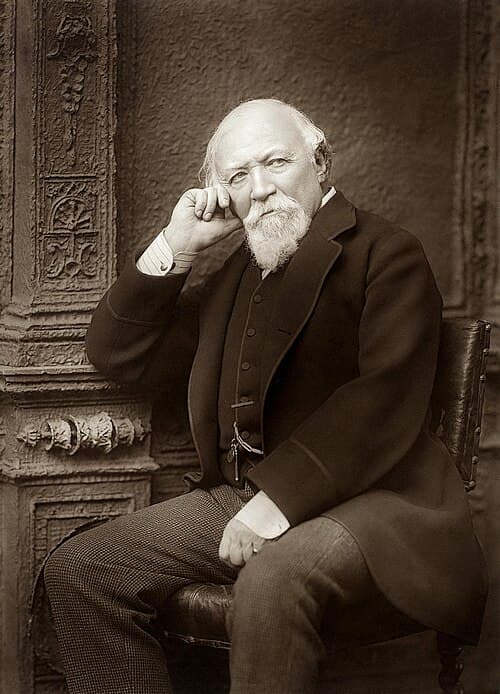
Robert Browning
- Lived
- Lived 1812 to 1889
- From
- From English
- Born in
- Born in Camberwell, London
Born on May 7, 1812, in Camberwell, a leafy suburb south of London, Browning was the son of a clerk at the Bank of England who possessed a library of six thousand volumes and a gentle, encyclopedic love of learning. His mother, Sarah Anna Wiedemann, was a devout Nonconformist of Scottish-German descent. Educated largely at home amid his father's books, Browning showed prodigious early talent: he reportedly composed verses at age twelve after reading Shelley, whose atheism and lyrical fire became a lifelong influence. His early long poems Pauline (1833) and Paracelsus (1835) won critical praise, but Sordello (1840), a labyrinthine historical narrative, was so willfully obscure that it damaged his reputation for over a decade. He turned instead to dramatic monologues, "My Last Duchess" (1842), "Porphyria's Lover" (1836), perfecting a form in which a single speaker unwittingly reveals the depths of his own character. In 1845 he began a courtship by letter with the poet Elizabeth Barrett, who was six years his senior, an invalid, and virtually imprisoned by her tyrannical father in the family home on Wimpole Street. They married secretly in 1846 and fled to Italy, where they lived, mostly in Florence, until Elizabeth's death in 1861. Browning returned to London and published Men and Women (1855) and the monumental The Ring and the Book (1868-1869), a retelling of a Roman murder case from twelve perspectives. By his death on December 12, 1889, in Venice, at his son's palazzo on the Grand Canal, he was regarded as one of the two great Victorian poets, alongside Tennyson. He was buried in Poets' Corner, Westminster Abbey.
In July 1855, at a seance in Ealing, a disembodied hand lowered a wreath of clematis onto Elizabeth's head, then passed it under the table to Robert. Elizabeth was convinced she had touched the beyond. Robert wrote furiously to The Times, calling the whole display a cheat and an imposture.
How gratifying!
The first button needs the app on this device; the second gets it there.
In the canon
- Porphyria's Lover1836
- My Last Duchess1842
- Childe Roland to the Dark Tower Came1855
- Rabbi Ben Ezra1864
- The Ring And The Book1868