
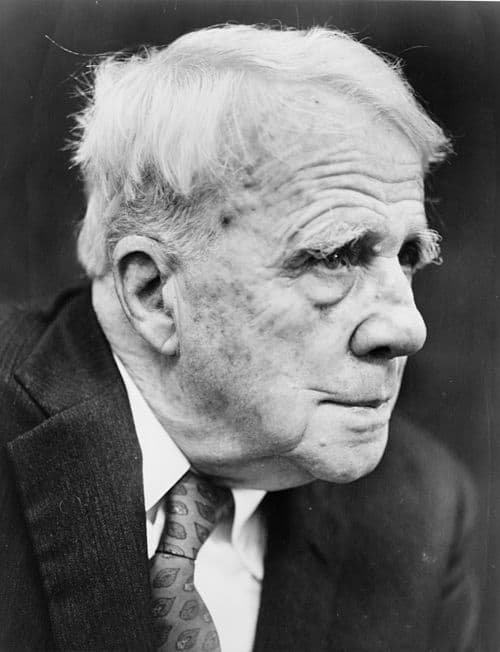
Author
Robert Frost
- Lived
- Lived 1874 to 1963
- From
- From American
- Born in
- Born in San Francisco, California
Born Robert Lee Frost on March 26, 1874, in San Francisco, the son of a hard-drinking journalist from New England and a Scottish-born mother who was also a teacher, Frost spent his first eleven years in California before his father's death from tuberculosis in 1885 brought the family east to Lawrence, Massachusetts. He shared the valedictorian honor at Lawrence High School with Elinor White, whom he married in 1895. He attended Dartmouth College for less than a semester and Harvard for two years without earning a degree, then spent a decade farming chickens in Derry, New Hampshire, while writing poetry that no American publisher would accept. In 1912, at thirty-eight, he sold the farm and took his family to England, where he published his first two collections, A Boy's Will (1913) and North of Boston (1914), to immediate acclaim. He befriended Edward Thomas and Ezra Pound, then returned to America in 1915 as an established poet. Over the following decades he became the most honored poet in American history, winning four Pulitzer Prizes for New Hampshire (1924), Collected Poems (1931), A Further Range (1937), and A Witness Tree (1943). His verse, deceptively simple, rooted in New England landscape and speech, concealed depths of darkness and ambiguity beneath its pastoral surfaces. In 1961, at eighty-six, he read "The Gift Outright" at John F. Kennedy's inauguration, the first poet to participate in a presidential ceremony. He died on January 29, 1963, in Boston, of complications from prostate surgery, at eighty-eight.
On a bitter January morning in 1961, Frost rose to read a poem written for Kennedy's inauguration, but sun glaring off the fresh snow washed out the page. Lyndon Johnson tried to shade it with his hat. The old man gave up and recited The Gift Outright from memory instead.
The first button needs the app on this device; the second gets it there.
In the canon
- Mowing1913
- North Of Boston1914
- The Road Not Taken1916
- Mountain Interval1916
- Stopping by Woods on a Snowy Evening1923
- Acquainted with the Night1928