
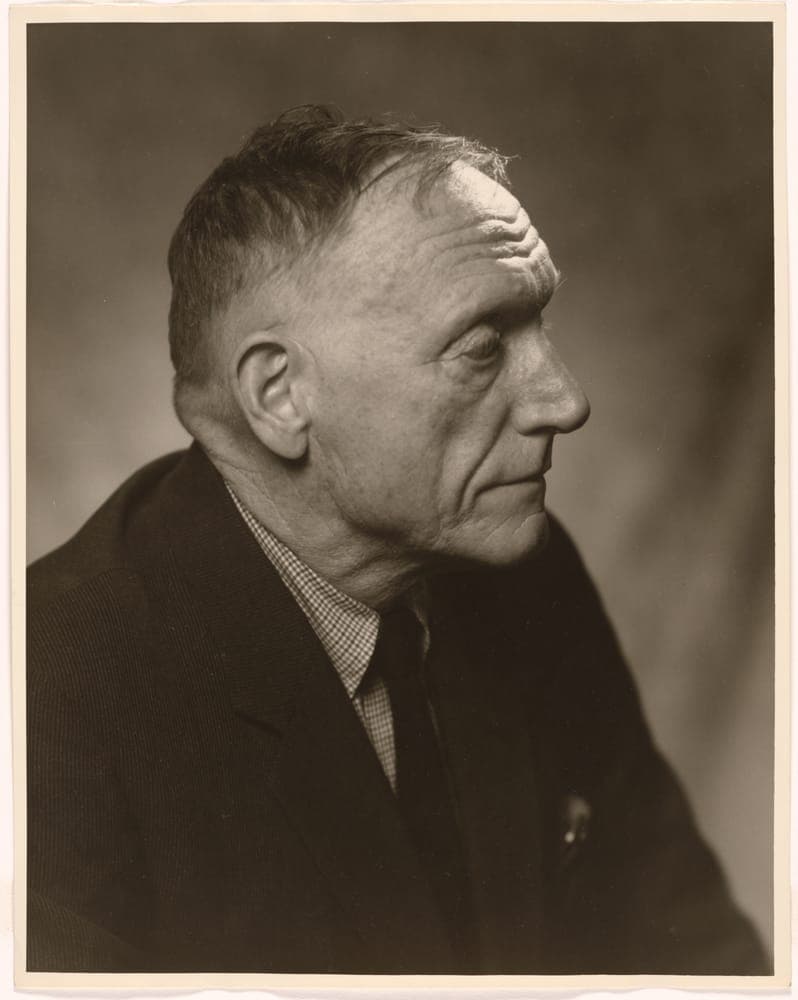
Author
Robert Penn Warren
- Lived
- Lived 1905 to 1989
- From
- From American
- Born in
- Born in Guthrie, Kentucky
Born Robert Penn Warren on April 24, 1905, in Guthrie, Kentucky, near the Tennessee border, the son of Robert Warren, a banker who had wanted to be a poet, and Anna Penn, a descendant of Revolutionary War soldier Colonel Abram Penn, he grew up listening to his Confederate-veteran grandfather recite Tennyson on the porch of a tobacco farm. A piece of coal thrown over a hedge by his younger brother in 1921 cost him his left eye and canceled his appointment to the Naval Academy. He entered Vanderbilt at sixteen instead, where John Crowe Ransom and Donald Davidson drew him into the Fugitive poets and, later, the Southern Agrarian manifesto I'll Take My Stand (1930). He took a master's at Berkeley, a year at Yale, and read at New College, Oxford, on a Rhodes Scholarship, completing his B.Litt. in 1930. With Cleanth Brooks he founded The Southern Review at LSU in 1935 and the textbook Understanding Poetry (1938), which gave a generation of American students the close-reading method of the New Criticism. All the King's Men (1946), the story of the demagogue Willie Stark told by the disenchanted Jack Burden and modelled loosely on Huey Long, won the Pulitzer Prize for fiction. He went on to win the Pulitzer for poetry twice, in 1958 for Promises and in 1979 for Now and Then, the only writer to win in both categories. He recanted his early defence of segregation in Segregation: The Inner Conflict in the South (1956) and gathered interviews with Malcolm X and Martin Luther King Jr. in Who Speaks for the Negro? (1965). He taught at Yale until 1973. He died of bone cancer at his summer home in Stratton, Vermont, on September 15, 1989, at eighty-four.
In the spring of 1921, Warren lay in his family's yard in Guthrie when his younger brother, tossing chunks of coal into the air, struck him in the left eye. The injury cost him the eye and, with it, his appointment to the Naval Academy. He enrolled at Vanderbilt instead and found the Fugitive poets.
The first button needs the app on this device; the second gets it there.
In the canon
- All the King's Men1946
- Audubon1969