
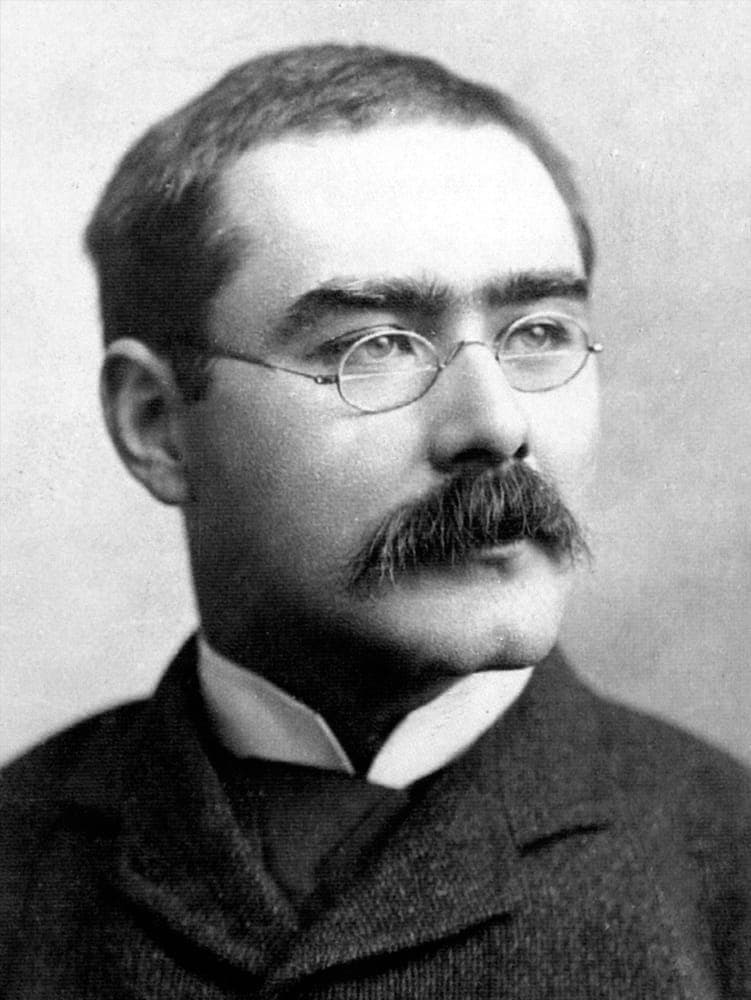
Author
Rudyard Kipling
- Lived
- Lived 1865 to 1936
- From
- From British
- Born in
- Born in Bombay, India
Born Joseph Rudyard Kipling on December 30, 1865, in Bombay, the son of John Lockwood Kipling, professor of architectural sculpture at the new Sir J. J. School of Art, and the vivacious Alice MacDonald, of whom Lord Dufferin said dullness and Mrs Kipling could not exist in the same room, he was named for the Staffordshire lake by which his parents had courted. He spoke Hindustani with his ayah before he spoke English with his mother, and remembered Bombay as a place of strong light and darkness. At five he and his sister were sent to lodge in Southsea with a sadistic foster couple in what he later called the House of Desolation. At seventeen he returned to India to work as a sub-editor on the Civil and Military Gazette in Lahore; Plain Tales from the Hills (1888) was written in the small hours after the day's copy. He married the American Carrie Balestier in 1892 and settled briefly in Vermont, where The Jungle Book (1894) and The Second Jungle Book (1895) were written and where he and his brother-in-law famously fell out in public. They returned to England and built a house at Burwash in Sussex. He won the Nobel Prize in 1907 at forty-one, the youngest laureate to date. His son John was killed at the Battle of Loos in September 1915 at eighteen, in the Irish Guards regiment Kipling had pulled strings to get him into despite his weak eyesight; the loss haunted his late work and his commission for the Imperial War Graves Commission. He died on January 18, 1936, in London, at the age of seventy, of a perforated duodenal ulcer, and was cremated and buried in Poets' Corner at Westminster Abbey.
In August 1889, twenty-three and still almost unknown outside India, Kipling took a train partway across America to knock, uninvited, on Mark Twain's door in Elmira, New York. Twain received him, and for two hours the two talked about copyright, conscience, and the impossibility of true autobiography.
The first button needs the app on this device; the second gets it there.
In the canon
- The Jungle Book1894
- Captains Courageous1897
- Kim1901
- Just So Stories1902
- Something of Myself1937