
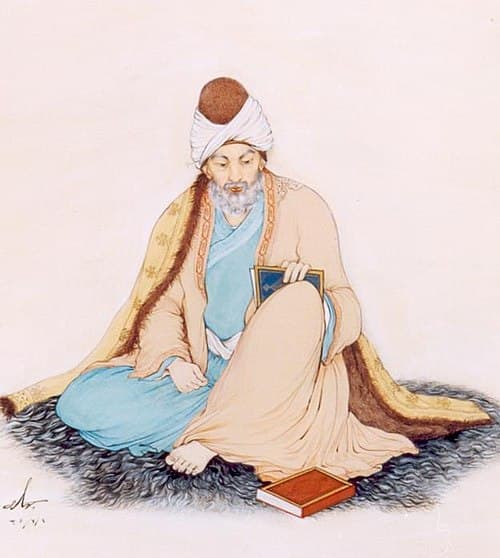
Author
Rumi
- Lived
- Lived 1207 to 1273
- From
- From Persian
- Born in
- Born in Balkh, Khwarazmian Empire (present-day Afghanistan)
Born on September 30, 1207, in Balkh in the Khwarazmian Empire (present-day Afghanistan), Jalal al-Din Muhammad Rumi was the son of Baha al-Din Walad, a theologian and mystic of considerable local renown. The family fled westward before the advancing Mongol armies when Rumi was still a child, passing through Baghdad and Damascus before settling in Konya, in the Sultanate of Rum, hence his name, "the Roman." He followed his father into religious scholarship and succeeded him as head of a madrasa. His life was transformed utterly in 1244 by the arrival of Shams-i-Tabrizi, a wandering dervish whose intensity and spiritual daring drew Rumi into an all-consuming friendship. When Shams mysteriously disappeared, likely murdered by jealous disciples, Rumi's grief became the furnace of his poetry. The Divan-e Shams-e Tabrizi, some forty thousand verses of ecstatic lyric, poured out of him as both elegy and spiritual testament. His other masterwork, the Masnavi-ye Ma'navi, runs to over twenty-five thousand couplets and has been called the Persian Quran for its depth and authority. Rumi founded the Mevlevi Order, whose whirling dance became the physical expression of his theology of divine love and annihilation of the self. He died on December 17, 1273, in Konya, and his funeral was attended by Muslims, Christians, and Jews alike, all claiming him as their own.
After Shams vanished a second time in 1248, Rumi rode to Damascus twice, certain he could find him among its markets and mosques. He never did. Searching the city's streets taught him a different lesson: Shams's voice now spoke through his own. He returned to Konya and began signing his poems with his friend's name.
The first button needs the app on this device; the second gets it there.
In the canon
- The Masnavi1273
- The Guest House1273
- Fihi Ma Fihi1273
- Spiritual Verses1273