
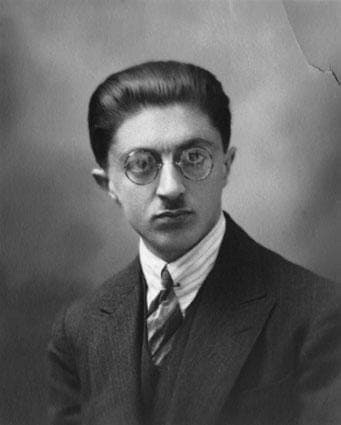
Author
Ṣādiq Hidāyat
- Lived
- Lived 1903 to 1951
- From
- From Iranian
- Born in
- Born in Tehran, Iran
Born Sadeq Hedayat on February 17, 1903, in Tehran to an aristocratic family that had produced generals, poets, and cabinet ministers, he attended a French Catholic school in the capital before being sent to Europe in the mid-1920s, first to Belgium to study engineering, then to France, where he drifted through architecture and dentistry without finishing either. In 1927, undone by a failed love affair in Paris, he waded into the Marne meaning not to come back; a passing boatman pulled him out, and he wrote home to his brother, half embarrassed, that he had done something reckless. Back in Tehran by 1930, he supported himself with government clerking jobs while gathering with three friends, Bozorg Alavi, Mas'ud Farzad, and Mojtaba Minovi, into a maverick literary circle the four of them nicknamed the Rab'e, translating Kafka and Chekhov and pulling Persian prose toward the modern short story. A year spent in Bombay's Zoroastrian community let him study Middle Persian under the scholar Bahramgore Anklesaria, and there, in 1937, he privately printed fifty lithographed copies of The Blind Owl, stamping the title page not for sale or circulation in Iran to keep it clear of the censors who had already forced a pledge of silence from him. The novel, a fevered confession poured out by an opium addicted painter to his own shadow, would not reach Iranian readers in a newspaper until 1941, after Reza Shah's abdication loosened the press, and it has since been read as the founding work of Iran's modern fiction. Hedayat never married, kept no permanent home, and grew steadily more despondent through the 1940s. In the spring of 1951 he traveled to Paris, tore up his unfinished manuscripts, and on April 9 sealed his rented apartment with cotton and turned on the gas, leaving a note that read: I left and broke your heart, that is all. He was forty-eight, and is buried in Père Lachaise Cemetery.
In 1928, reeling from a failed love affair in Paris, Hedayat waded into the Marne one night meaning not to come out. A passing boatman fished him out, half drowned. Sheepish, he wrote home to his brother in Tehran that he had done something reckless, but it had turned out fine.
I left and broke your heart. That is all.
The first button needs the app on this device; the second gets it there.
In the canon
- The Blind Owl1937