
Author
Saint Augustine
- Lived
- Lived 354 CE to 430 CE
- From
- From North African
- Born in
- Born in Thagaste, Numidia (present-day Algeria)
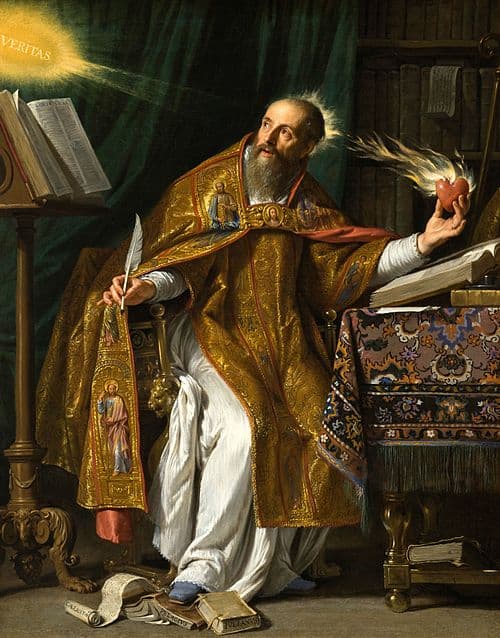
Born on November 13, 354, in Thagaste in the Roman province of Numidia (present-day Souk Ahras, Algeria), Aurelius Augustinus was the son of Patricius, a pagan Roman official, and Monica, a devout Christian whose relentless prayers for her son's conversion would eventually make her a saint. As a young man in Carthage he took a concubine, fathered a son named Adeodatus, and embraced Manichaeism, a dualist religion his mother regarded with horror. He taught rhetoric in Rome and Milan, where the sermons of Bishop Ambrose began to crack his intellectual resistance. The crisis came in a garden in Milan in 386, when he heard a child's voice chanting "Take up and read"; he opened Paul's Epistle to the Romans and his resistance collapsed. He was baptized the following Easter. Returning to North Africa, he was ordained a priest in 391 and became Bishop of Hippo Regius in 396, a position he held for thirty-four years. The Confessions (397–400), the first great autobiography in Western literature, narrated his spiritual journey with unprecedented psychological depth. The City of God (426), written after the Visigoths sacked Rome in 410, reimagined the relationship between earthly power and divine providence. He died on August 28, 430, as the Vandals besieged his city, having shaped Western theology more profoundly than any figure between Saint Paul and Martin Luther.
When his mother arranged a respectable marriage in Milan, Augustine was made to send away the woman he had lived with for some fifteen years, the mother of his son. She sailed back to Africa vowing to know no other man. He never once records her name, only that she was torn from his side and his heart went on bleeding.
The first button needs the app on this device; the second gets it there.
In the canon
- On Free Will395 CE
- On Christian Doctrine397 CE
- Confessions400 CE
- On the Trinity400 CE
- The City of God413 CE
- Enchiridion421 CE