
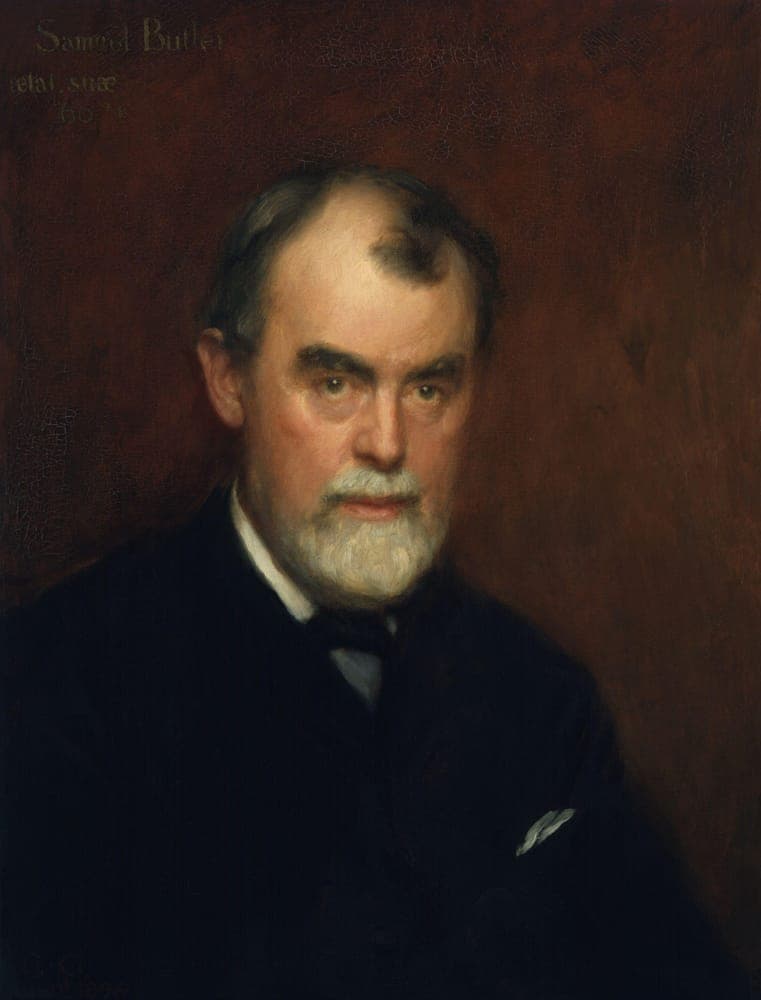
Author
Samuel Butler
- Lived
- Lived 1835 to 1902
- From
- From English
- Born in
- Born in Langar, Nottinghamshire
Born on December 4, 1835, at the rectory in the village of Langar, Nottinghamshire, Samuel Butler was the son of Reverend Thomas Butler, a domineering Anglican clergyman, and the grandson of a famous headmaster of Shrewsbury School. The household was oppressive: frequent beatings, brutal piety, and constant pressure on the boy to follow his father into the priesthood. Sent to Shrewsbury at twelve, then up to St John's College, Cambridge, where he took a first in Classics in 1858, Butler tried a slum parish in London and lost his faith over the question of infant baptism. In September 1859 he boarded the Roman Emperor and emigrated to New Zealand, running a sheep station on the South Island, reading Darwin in the high country, and amassing the material that would become Erewhon (1872), an anonymous satire whose unmasking made him briefly famous. He spent the rest of his life in rooms at Clifford's Inn near Fleet Street, writing on Darwinian theory, Italian religious art, the authorship of the Odyssey (which he believed to be by a Sicilian woman), and Shakespeare's sonnets. He produced prose translations of the Iliad and Odyssey that are still consulted. The Way of All Flesh, his ferocious account of Victorian family life under a tyrannical clergyman father, was completed by 1884 but withheld during his lifetime and published in 1903, the year after his death. Butler kept a notebook for thirty years that ran to thousands of aphorisms. He never married, lived frugally on inherited income after his father's death in 1886, and travelled often to northern Italy. He died on June 18, 1902, in London, at the age of sixty-six, the Way of All Flesh still locked in his desk.
At twenty-three, working in a London parish, he noticed that the boys who had been baptised behaved no better than the boys who had not. He told his father he could not be ordained. The row ended with a berth on the Roman Emperor and four years farming sheep in the New Zealand high country.
The first button needs the app on this device; the second gets it there.
In the canon
- Erewhon1872
- Way of All Flesh1903