
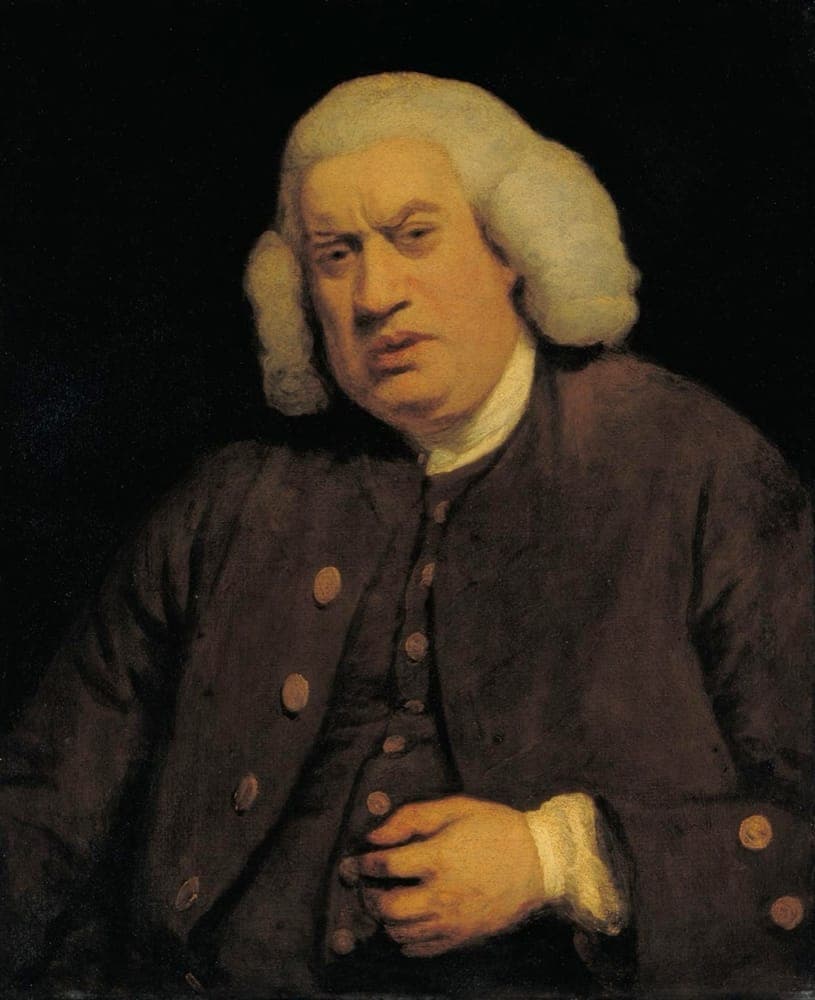
Author
Samuel Johnson
- Lived
- Lived 1709 to 1784
- From
- From English
Born on September 18, 1709, in Lichfield, Staffordshire, Samuel Johnson was the son of a struggling bookseller and entered the world so sickly that he was baptised the same day for fear he would not survive. Scrofula left him scarred and nearly blind in one eye, and he was touched for the disease by Queen Anne as an infant. He read voraciously among his father's stock, won a place at Pembroke College, Oxford, in 1728, but poverty forced him to leave after thirteen months without a degree. He married Elizabeth Porter, a widow twenty years his senior, and in 1737 walked to London with his former pupil David Garrick to seek a living by his pen. There he wrote for the Gentleman's Magazine, produced the poem London (1738) and The Vanity of Human Wishes (1749), and edited a series of moral essays as The Rambler. His Dictionary of the English Language (1755), compiled almost single-handedly over nine years with six amanuenses, fixed the spelling and sense of the language for generations and brought him fame if not fortune. The History of Rasselas, Prince of Abissinia (1759), a philosophical tale on the choice of life, he wrote in the evenings of a single week to pay for his mother's funeral. A pension from George III eased his last decades, in which he produced an edition of Shakespeare (1765) and the Lives of the Poets (1779-1781). His talk, recorded by his friend James Boswell, made him the most quoted conversationalist in English. He died on December 13, 1784, in London, at the age of seventy-five, and was buried in Westminster Abbey.
The first button needs the app on this device; the second gets it there.
In the canon
- A Dictionary of the English Language1755
- A Journey to the Western Islands of Scotland1775
- The Journal of a Tour to the Hebrides1785