
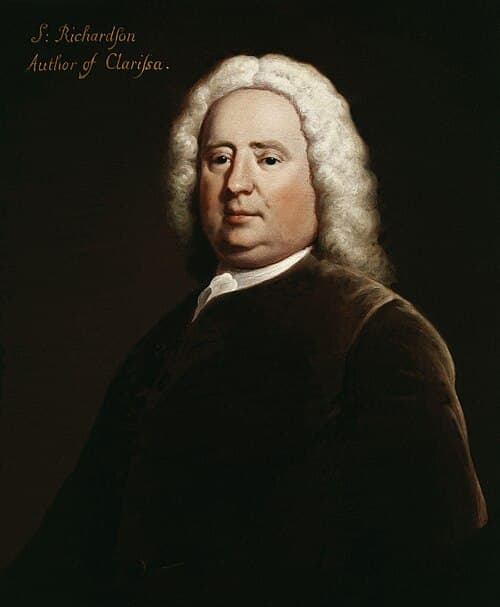
Author
Samuel Richardson
- Lived
- Lived 1689 to 1761
- From
- From English
- Born in
- Born in Mackworth, Derbyshire
Baptised on August 19, 1689, in Mackworth, Derbyshire, Samuel Richardson was the son of a joiner who could not afford to give him a university education. He was apprenticed at seventeen to a London printer named John Wilde, eventually marrying Wilde's daughter Martha. The marriage was marked by tragedy: all six of their children died in infancy or during childbirth, and Martha herself died in 1731. He married Elizabeth Leake, daughter of another printer, in 1733, and four of their six children survived. For decades he was simply a prosperous tradesman, running one of the busiest printing houses in London and producing nearly five hundred works, including journals and government publications. Then, at the age of fifty-one, he wrote Pamela; or, Virtue Rewarded (1740), an epistolary novel about a servant girl who resists her master's advances. It was an instant sensation and is often regarded as one of the first true English novels. Henry Fielding parodied it savagely in Shamela, inaugurating one of literature's great rivalries. Richardson's masterpiece, Clarissa: Or the History of a Young Lady (1748), runs to nearly a million words and is among the longest novels in the English language, a harrowing study of virtue besieged that moved Denis Diderot to call Richardson the equal of Homer and Euripides. He died on July 4, 1761, in London, having transformed the novel from entertainment into a vehicle for psychological depth.
At thirteen, three girls in his neighborhood, strangers to one another, each came to him separately with the same request: draft the love letters they were too shy to write themselves. Richardson kept their secrets and supplied the words, first practicing in someone else's voice the intimate confession he would spend his life perfecting.
The first button needs the app on this device; the second gets it there.
In the canon
- Pamela1740
- Clarissa1748
- Sir Charles Grandison1753