
Author
Seamus Heaney
- Lived
- Lived 1939 to 2013
- From
- From Irish
- Born in
- Born in County Derry, Northern Ireland
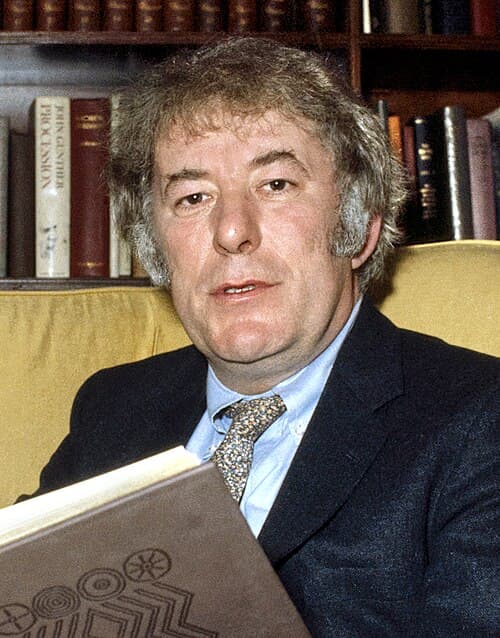
Born on April 13, 1939, in the townland of Tamniaran, near Castledawson in County Derry, Northern Ireland, Seamus Justin Heaney was the eldest of nine children on a Catholic family farm. His father, Patrick, was a cattle dealer, and the rural world of wells, turf bogs, and ploughed fields became the central territory of his poetry. He won a scholarship to St Columb's College in Derry and then attended Queen's University Belfast, where he began writing under the influence of Ted Hughes and Patrick Kavanagh. His first major collection, Death of a Naturalist (1966), announced a voice of extraordinary sensory precision, poems that made you smell the flax-dam and feel the cold of a pump handle. The Troubles in Northern Ireland pressed upon his conscience throughout the 1970s, and North (1975) responded with poems that linked contemporary violence to the bog bodies of Iron Age Scandinavia. He moved to the Republic of Ireland in 1972, eventually settling in Sandymount, Dublin. Robert Lowell called him "the most important Irish poet since Yeats." He taught at Harvard from 1981 to 1997 and served as Oxford Professor of Poetry from 1989 to 1994. His translation of Beowulf (1999) became an unlikely bestseller. He won the Nobel Prize in Literature in 1995. His last words, texted in Latin to his wife Marie minutes before he died on August 30, 2013, were "Noli timere", "Don't be afraid."
In 1982 the Penguin Book of Contemporary British Poetry claimed him for Britain. Heaney answered the next year with a verse pamphlet, An Open Letter: 'be advised / My passport's green. / No glass of ours was ever raised / To toast the Queen.' He would not be labelled British.
Noli timere.
The first button needs the app on this device; the second gets it there.
In the canon, 22 works
- Digging1966
- Blackberry-Picking1966
- Mid-Term Break1966
- Follower1966
- Personal Helicon1966
- Bogland1969
- Punishment1975
- Funeral Rites1975
- Bog Queen1975
- The Grauballe Man1975
- Exposure1975
- Glanmore Sonnets1979