
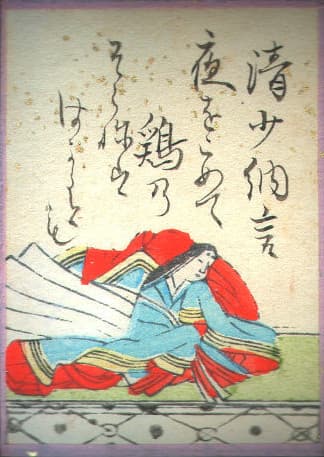
Author
Sei Shōnagon
- Lived
- Lived 966 CE to 1025
- From
- From Japanese
- Born in
- Born in Heian-kyō (Kyoto), Japan
Born around 966 into the Kiyowara clan, a family distinguished for its poets and scholars, the woman known as Sei Shonagon served as a lady-in-waiting to Empress Teishi at the Heian court in Kyoto around the year 1000. Her real name is unknown; "Sei" derives from an alternate reading of the first character of her family name, Kiyowara, and "Shonagon" was a court rank. Her father, Kiyowara no Motosuke, was a noted poet whose work appeared in imperial anthologies. Almost nothing is known of her life outside the court, but what she wrote there became one of the enduring masterpieces of Japanese literature. The Pillow Book (Makura no Soshi) is a miscellany of lists, anecdotes, character sketches, descriptions of nature, and sharp social observations composed during her years of service. Its famous opening, "In spring, the dawn", established a mode of aesthetic attention that influenced Japanese prose for a millennium. She catalogued things that quicken the heart, things that are hateful, things that are elegant and things that are embarrassing, with an eye so precise and a wit so merciless that her contemporary Murasaki Shikibu, author of The Tale of Genji, called her "dreadfully conceited." The two women are often paired as the great prose writers of the Heian period, Murasaki the novelist of depth, Sei the essayist of surface brilliance. After Empress Teishi's death in the year 1001, Sei Shonagon likely left court; the details of her later life and death, sometime around 1017 or 1025, remain obscure.
In 996, Minamoto no Tsunefusa, governor of Ise, visited and sat on a cushion in her room, not knowing her private notebook lay hidden beneath it. He found the pages, snatched them despite her protests, and carried them off. Soon the whole court was reading words she had written only for herself.
The first button needs the app on this device; the second gets it there.
In the canon
- The Pillow Book1002