
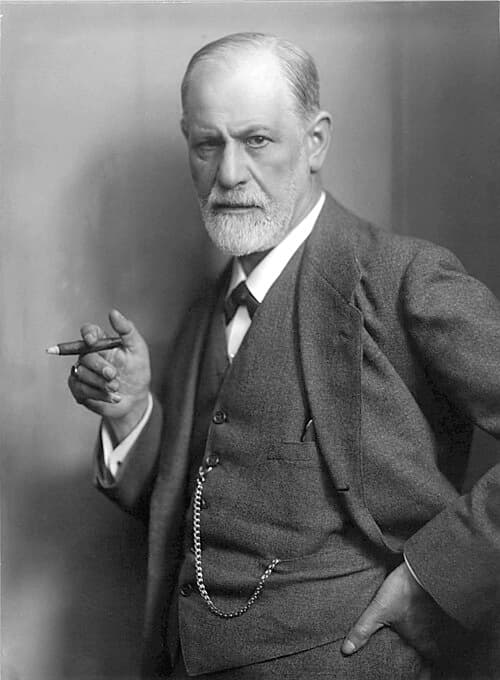
Author
Sigmund Freud
- Lived
- Lived 1856 to 1939
- From
- From Austrian
- Born in
- Born in Freiberg, Moravia
Born Sigismund Schlomo Freud on May 6, 1856, in Freiberg, Moravia (now Pribor, Czech Republic), to a Jewish wool merchant and his much younger third wife, Freud moved to Vienna at the age of four and remained there for nearly eight decades. He qualified as a doctor of medicine at the University of Vienna in 1881 and spent years in neurological research before opening a private practice in 1886. His collaboration with Josef Breuer on Studies on Hysteria (1895) introduced the "talking cure" that would become the foundation of psychoanalysis. The Interpretation of Dreams (1900), published at the turn of the century to almost no notice, laid out his theory of the unconscious mind and the significance of dreams as wish fulfillment. He gathered a circle of followers, Jung, Adler, Ferenczi, most of whom eventually broke with him in bitter schisms. His concepts, the Oedipus complex, the id, ego, and superego, repression, transference, reshaped not only psychiatry but literature, art, and the way modern people understand themselves. Civilization and Its Discontents (1930) argued that human society rests on the suppression of instinct. Following the Nazi annexation of Austria in March 1938, he fled to London, aided by Princess Marie Bonaparte, who paid a ransom to the Gestapo for his release. He died on September 23, 1939, in Hampstead, after asking his physician to administer a fatal dose of morphine to end the suffering of his oral cancer.
On 23 October 1896, Freud's father died in Vienna. The night after the funeral, he dreamed of a barbershop sign that read, 'You are requested to close the eyes.' He began analyzing his own dreams night after night, work that grew into The Interpretation of Dreams.
My dear Schur, you certainly remember our first talk. You promised me then not to forsake me when my time comes. Now it is nothing but torture and makes no sense any more.
The first button needs the app on this device; the second gets it there.
In the canon, 13 works
- The Interpretation of Dreams1899
- The Psychopathology Of Everyday Life1901
- The Joke and Its Relation to the Unconscious1905
- Three Essays on the Theory of Sexuality1905
- The Schreber Case1911
- Totem and Taboo1913
- The Uncanny1919
- A General Introduction to Psycho-Analysis1920
- Beyond the Pleasure Principle1920
- The Ego and the Id1923
- Civilization and Its Discontents1930
- Moses and Monotheism1939