
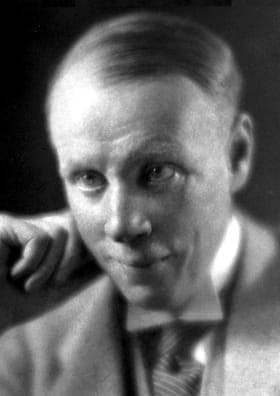
Author
Sinclair Lewis
- Lived
- Lived 1885 to 1951
- From
- From American
- Born in
- Born in Sauk Centre, Minnesota
Born Harry Sinclair Lewis on February 7, 1885, in the prairie village of Sauk Centre, Minnesota, the third son of a stern country physician of Welsh descent, he lost his mother to consumption at six and was raised by his father and stepmother. Tall, gawky, acne-stricken and pop-eyed, he was an outsider among the village boys; at thirteen he ran away from home to try to enlist as a drummer in the Spanish-American War. He went to Oberlin Academy and then to Yale in 1903, where he edited the Yale Literary Magazine and took five years to graduate, breaking off to work at Upton Sinclair's Helicon Home Colony in New Jersey. He drifted through editorial jobs in San Francisco and Carmel, briefly meeting Jack London and ghostwriting plots for him, before producing his first serious novel, Our Mr. Wrenn, in 1914. Main Street (1920), his satire of the smug life of Gopher Prairie, sold a hundred and eighty thousand copies in its first six months and made him rich. Babbitt (1922) gave the language a noun for hollow business conformism; Arrowsmith (1925) won the Pulitzer, which he refused, still angry about Main Street's exclusion. Elmer Gantry (1927) was denounced from pulpits and banned in several cities. In 1930 he became the first American to win the Nobel Prize in Literature, the academy citing "his vigorous and graphic art of description and his ability to create, with wit and humor, new types of characters." It Can't Happen Here (1935) imagined a fascist demagogue elected to the American presidency. He drank heavily in his later years and died of advanced alcoholism in Rome on January 10, 1951, aged sixty-five.
In 1923, Lewis hired the bacteriologist Paul de Kruif to help research Arrowsmith, paying him a quarter of the royalties. They sailed to the West Indies to draft it together in isolation. Then in London, when de Kruif chose Easter with his family over a work session, Lewis fired him on the spot.
I am happy. God bless you.
The first button needs the app on this device; the second gets it there.
In the canon
- Main Street1920
- Babbitt1922
- Arrowsmith1925
- Elmer Gantry1927