
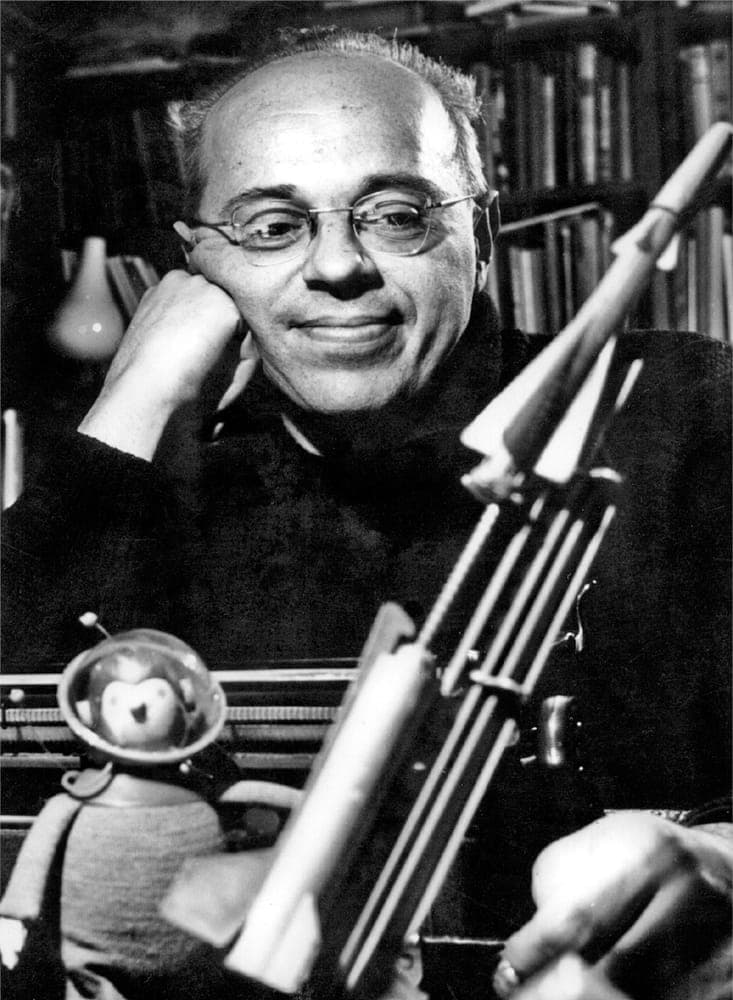
Author
Stanislaw Lem
- Lived
- Lived 1921 to 2006
- From
- From Polish
- Born in
- Born in Lwow, Poland (now Lviv, Ukraine)
Born Stanislaw Herman Lem on 13 September 1921 in Lwow, then in interwar Poland and now Lviv in Ukraine, he was the only child of Sabina Woller and Samuel Lem, a wealthy laryngologist who had served as a physician in the Austro-Hungarian Army. The Lems were assimilated Polish Jews. During the Nazi occupation of 1941 to 1944, the family avoided the Lwow Ghetto by living on false papers; Lem worked as a car mechanic and welder, occasionally stealing munitions from a German depot to pass to the Polish resistance. When Lwow was annexed to Soviet Ukraine in 1945, the family was resettled to Krakow, where he took up medical studies at the Jagiellonian University, deliberately failing his final examinations to avoid being conscripted as a military doctor. He published his first science fiction novel, The Astronauts, in 1951, after the censors had shelved his autobiographical Hospital of the Transfiguration. Following the thaw of 1956, he became one of the most productive writers in Europe, publishing Solaris in 1961, a novel in which a sentient planetary ocean refuses every attempt at human communication, then Summa Technologiae (1964), an essay that anticipated virtual reality and artificial intelligence two decades before either existed. Through Ijon Tichy and the Cyberiad tales he developed a comic vein that ran beneath the bleaker philosophical work. His books were translated into more than fifty languages and sold over forty-five million copies; Theodore Sturgeon wrote in 1976 that Lem was the most widely read science fiction writer in the world. When martial law fell on Poland in 1982 he went into exile in West Berlin and Vienna, returning home in 1988. He died on 27 March 2006 in Krakow, aged eighty-four, of heart disease.
In 1969 Andrei Tarkovsky and Friedrich Gorenstein wrote a screenplay of Solaris that moved two thirds of the story to Earth. Lem was furious and fought every departure from the novel. During one of their quarrels, he later recalled, he told Tarkovsky that he had not made Solaris at all; he had made Crime and Punishment.
The first button needs the app on this device; the second gets it there.
In the canon
- Solaris1961
- The Futurological Congress1971