
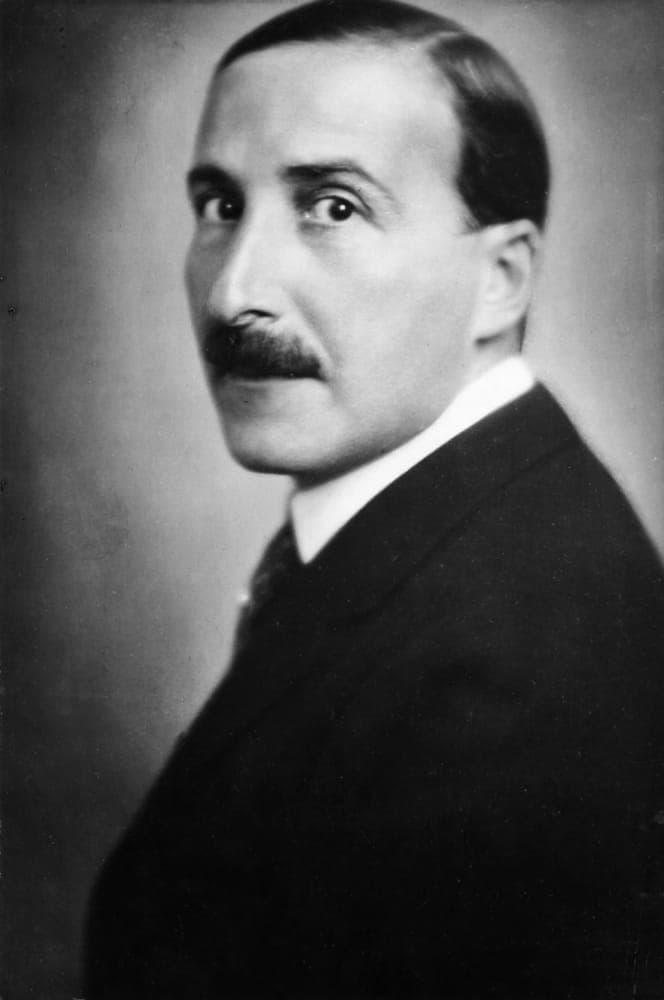
Author
Stefan Zweig
- Lived
- Lived 1881 to 1942
- From
- From Austrian
- Born in
- Born in Vienna, Austria-Hungary
Born on November 28, 1881, in Vienna, the son of a wealthy Jewish textile manufacturer, Moritz Zweig, and Ida Brettauer, whose family had built its fortune in banking, Stefan Zweig grew up inside the security of the late Habsburg bourgeoisie he would later mourn as the world of yesterday. He studied philosophy at the University of Vienna, earning a doctorate in 1904 with a thesis on Hippolyte Taine, and had already begun publishing poems and translating Verlaine, Baudelaire, and the Belgian poet Émile Verhaeren, whose friendship and mentorship shaped his early taste. Travel became a second education: Paris, Berlin, India, and the Americas, alongside long friendships with Rainer Maria Rilke, Romain Rolland, and Sigmund Freud, formed a cosmopolitan, pacifist outlook that hardened while he worked in Vienna's war archive during the First World War and wrote the antiwar drama Jeremiah in Swiss exile. Through the 1920s he became one of the most translated writers alive, prized for taut psychological novellas, Letter from an Unknown Woman, Amok, Confusion, Twenty-Four Hours in the Life of a Woman, and for biographical studies of Balzac, Joseph Fouché, and Marie Antoinette. He married Friderike von Winternitz in 1920; the marriage ended in 1938. When the Nazis burned his books in Berlin in 1933, Zweig left Austria for England, settling in London and then Bath, where in 1939 he married his secretary, Lotte Altmann, the same year his only full-length novel, Beware of Pity, appeared. Stripped of the German-language readership and European home his identity had rested on, he sailed in 1940 for New York and then Brazil, eventually settling in the hill town of Petrópolis. There, in February 1942, a day after finishing the manuscript of his memoir, The World of Yesterday, and shortly after completing the novella The Royal Game, Zweig and Lotte took a fatal dose of barbiturates together, ending a life he had come to feel had no home left in it.
In the summer of 1936, in the Belgian resort of Ostend, Zweig gathered a circle of exiled writers around him and quietly paid his ruined friend Joseph Roth's hotel bills and drink tabs while his own books were being burned back home. Roth, drinking himself toward death, could still hand Zweig the ending he needed for a stalled manuscript.
I greet all my friends! May they live to see the dawn after the long night is over! I, all too impatient, am going on alone.
The first button needs the app on this device; the second gets it there.
In the canon
- Amok1922
- Twenty Four Hours In The Life Of A Woman1927
- Decisive Moments in History1927
- Confusion1927
- Beware Of Pity1939
- The Royal Game1941
- The World Of Yesterday1942
- Chess1942
- Chess Story1942
- Balzac1946