
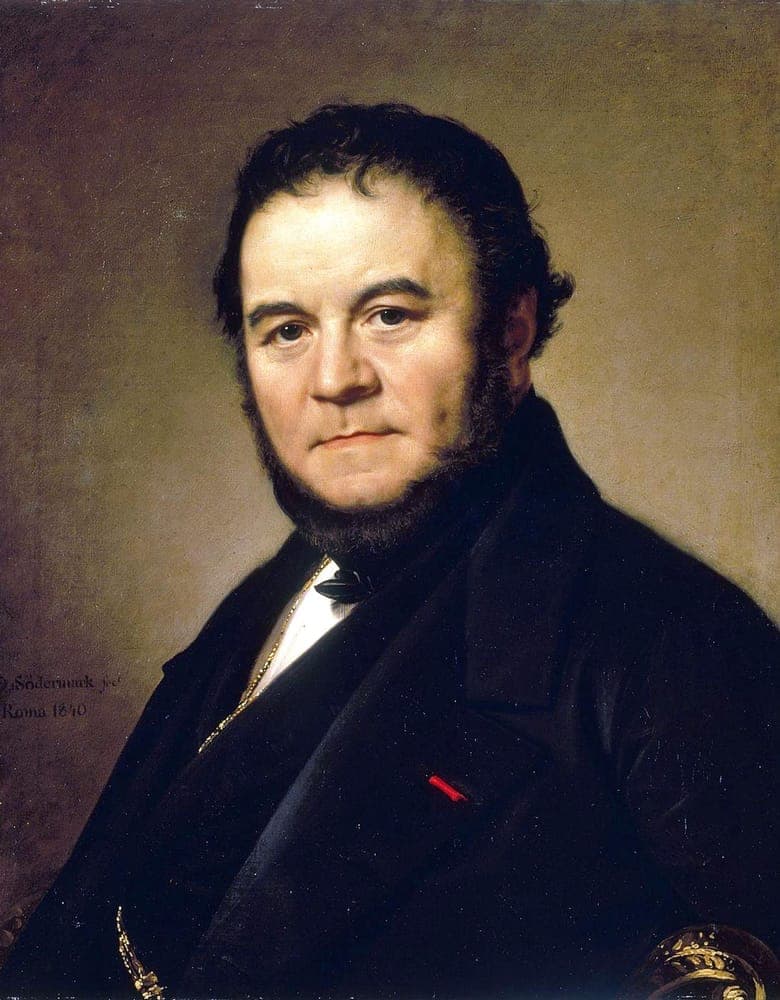
Author
Stendhal
- Lived
- Lived 1783 to 1842
- From
- From French
- Born in
- Born in Grenoble, France
Born Marie-Henri Beyle on January 23, 1783, in Grenoble, into the family of a provincial lawyer and royalist, he was a wretched child who detested his father and adored the mother he lost to childbirth when he was seven. He fled Grenoble at sixteen for Paris and the army, attaching himself to Napoleon's campaigns and crossing the Alps with the Italian invasion in 1800. He served as an auditor to the Conseil d'État, witnessed the burning of Moscow from the city's outskirts in 1812, and recrossed the Berezina by finding a usable ford rather than the overwhelmed pontoon bridge, a piece of cold-headed luck that almost certainly saved his life. After Napoleon's fall he settled in Milan, lived for some years on borrowed Italian air, and adopted the pen name Stendhal in 1817, taken from a small Prussian town he had passed through. The Red and the Black (1830), the story of Julien Sorel's ascent from carpenter's son to seminarian to murderer, set the psychology of ambition against the post-Napoleonic Restoration with a precision no French novel had yet attempted. The Charterhouse of Parma (1839), drafted in fifty-two days, traced its young Fabrice through the chaos of Waterloo and the intrigues of an Italian court. He wrote in obscurity, believing he would be read in 1880 or 1900, and called himself a hunter who shot for the next century. He died of a stroke on the rue Neuve-des-Petits-Champs in Paris on March 23, 1842, at the age of fifty-nine, his books unsold, his epitaph a Milanese formula he had chosen himself: "wrote, loved, lived."
In 1817, standing before Giotto's frescoes in the Basilica of Santa Croce in Florence, Stendhal felt his heart race, his legs weaken, and the world tilt until he had to sit on a bench to keep from fainting. He recorded the episode in his travel writing. Psychiatrists later named the syndrome after him.
The first button needs the app on this device; the second gets it there.
In the canon
- Love (De L'Amour)1822
- The Red and the Black1830
- The Charterhouse of Parma1839
- The Life of Henri Brulard1890