
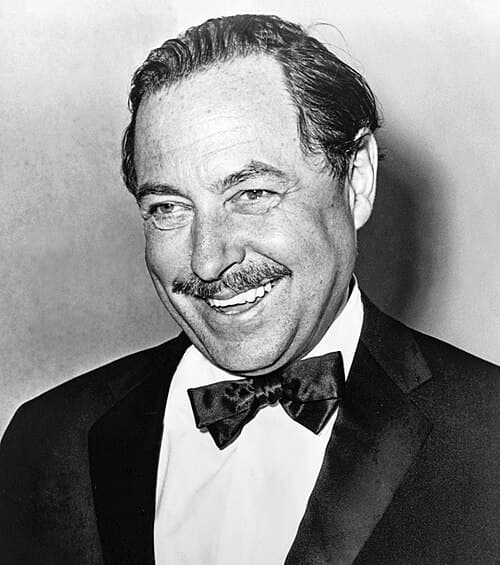
Author
Tennessee Williams
- Lived
- Lived 1911 to 1983
- From
- From American
- Born in
- Born in Columbus, Mississippi
Born Thomas Lanier Williams III on March 26, 1911, in Columbus, Mississippi, in the rectory of his grandfather’s Episcopal church, Tennessee Williams spent his early childhood in a household dominated by his stern, hard-drinking father , a traveling shoe salesman , and his fiercely genteel Southern mother. The family moved to St. Louis in 1918, a displacement from the warmth of the South that Williams never forgave and never stopped dramatizing. He adopted the name “Tennessee” in his twenties, claiming the nickname honored his father’s home state. After years of obscurity and odd jobs , working in a shoe warehouse much like his alter ego Tom Wingfield , he achieved sudden fame with The Glass Menagerie (1944), a “memory play” that reinvented American theatrical form with its poetic narration and translucent staging. A Streetcar Named Desire (1947) followed, winning the Pulitzer Prize and introducing Blanche DuBois, one of the most indelible characters in dramatic literature. Cat on a Hot Tin Roof (1955) won a second Pulitzer. His plays , raw explorations of desire, loneliness, mendacity, and the fragility of the human spirit , drew on his own struggles with alcoholism, depression, and his homosexuality, which he lived with increasing openness in an era of persecution. He continued writing prolifically through the 1960s and 1970s, though critical reception grew harsher. He died on February 25, 1983, in his suite at the Hotel Elysée in New York City, choking on the cap of a barbiturate bottle at the age of seventy-one.
In 1943, Williams learned his mother had authorized a prefrontal lobotomy for his elder sister Rose, diagnosed with schizophrenia. The operation left her institutionalized for life. He rewrote the trauma for decades, most nakedly in Suddenly Last Summer, where a mother schemes to have her daughter's mind cut away.
The first button needs the app on this device; the second gets it there.
In the canon
- The Glass Menagerie1944
- A Streetcar Named Desire1947
- Summer and Smoke1948
- Cat on a Hot Tin Roof1955
- Suddenly Last Summer1958
- Sweet Bird of Youth1959
- The Night of the Iguana1961