
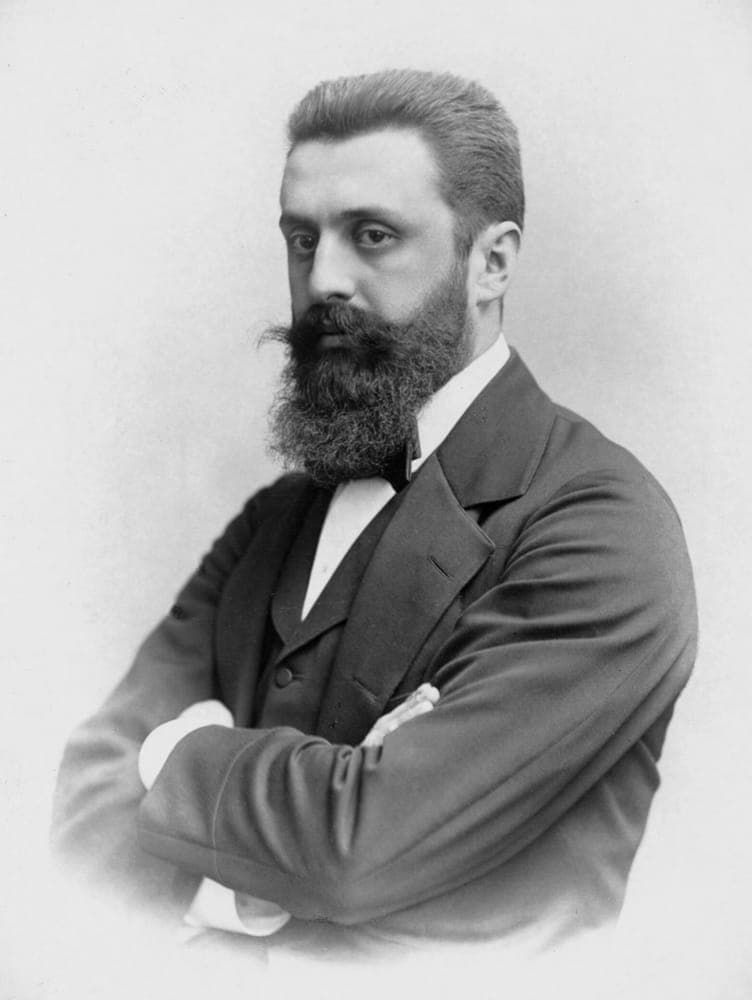
Author
Theodor Herzl
- Lived
- Lived 1860 to 1904
- From
- From Austro-Hungarian
- Born in
- Born in Pest, Hungary
Born Benjamin Ze'ev Herzl on May 2, 1860, in Pest, then part of the Kingdom of Hungary in the Austro-Hungarian Empire, he was raised in a German-speaking, assimilated Jewish household of comfortable means. His sister Pauline died when he was eighteen, and the family moved to Vienna, where Herzl studied law at the University of Vienna and took his doctorate in 1884. He practiced briefly in Vienna and Salzburg before turning to writing, producing feuilletons, essays, and light comedies for the stage. In 1891 the liberal newspaper Neue Freie Presse sent him to Paris as its correspondent, and it was there, covering the 1894 court-martial of Alfred Dreyfus and the cries of "Death to the Jews" in the streets, that his thinking turned. He concluded that assimilation would never end European antisemitism, and that the Jewish people needed a state of their own. In 1896 he published Der Judenstaat (The Jewish State), a slim pamphlet arguing for an organized Jewish homeland. The following year he convened the First Zionist Congress at Basel, founding the World Zionist Organization and serving as its president. He wrote in his diary that at Basel he had founded the Jewish State, and that in five years, or fifty, everyone would see it. He sought charters from the Ottoman sultan, the German kaiser, and the British government, and in 1902 published the utopian novel Altneuland (Old New Land), whose motto ran, "If you will it, it is no dream." He died of cardiac sclerosis on July 3, 1904, at Edlach, in Lower Austria, at the age of forty-four.
In November 1895 a friend, Emil Schiff, worried by Herzl's talk of a Jewish state, advised him to see a psychiatrist. Herzl went to Max Nordau in Paris, a physician and a famous critic. Nordau heard him out and closed the consultation by saying: "If you are insane, we are insane together. Count on me!"
The first button needs the app on this device; the second gets it there.
In the canon
- Der Judenstaat1896