
Author
Thomas Hardy
- Lived
- Lived 1840 to 1928
- From
- From English
- Born in
- Born in Higher Bockhampton, Dorset
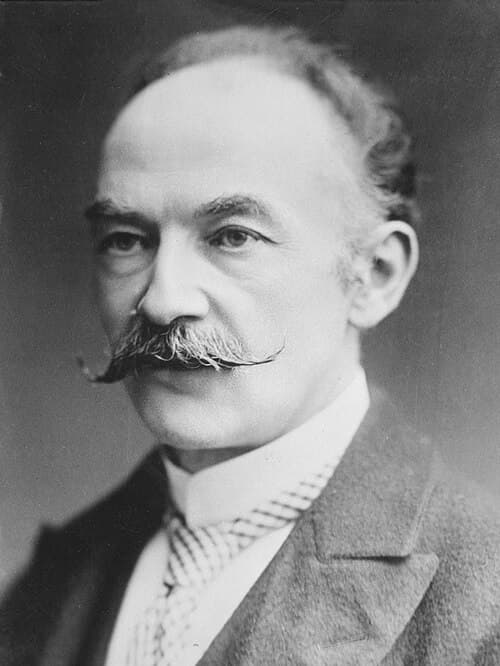
Born on June 2, 1840, in Higher Bockhampton, a hamlet in the parish of Stinsford, Dorset, Thomas Hardy was the son of a stonemason and builder whose family had known the region for centuries. The thatched cottage where he was born still stands at the end of a lane bordering the heath he would reimagine as Egdon Heath in The Return of the Native (1878). Thought dead at birth until the midwife intervened, Hardy grew up reading voraciously and was apprenticed at sixteen to a local architect, John Hicks. He practiced architecture in London for several years, winning prizes from the Royal Institute of British Architects, before turning to fiction. Far from the Madding Crowd (1874) made him famous and allowed him to marry Emma Lavinia Gifford and write full time. His novels , set in the semi-fictional region of Wessex , grew progressively darker: Tess of the d’Urbervilles (1891) and Jude the Obscure (1895), whose frank treatment of sexuality and religious doubt provoked such outrage that a bishop publicly burned his copy. Hardy abandoned fiction entirely after Jude and devoted the last three decades of his life to poetry, publishing eight collections and The Dynasts (1904–1908), a vast verse-drama of the Napoleonic Wars. He considered himself primarily a poet, and younger writers , Siegfried Sassoon, W. H. Auden, Philip Larkin , agreed. He died on January 11, 1928, at Max Gate, the house he had designed himself near Dorchester. His heart was buried at Stinsford beside Emma; the rest of his ashes were interred in Poets’ Corner at Westminster Abbey.
When Emma Hardy died in November 1912, the couple had been estranged for years, living at opposite ends of Max Gate. Grief overtook Hardy at seventy-two. The next spring he travelled alone to the Cornish coast where they had met in 1870, and the love poems of 1912-13 poured out of him.
Eva, what is this?
The first button needs the app on this device; the second gets it there.
In the canon, 16 works
- Desperate Remedies1871
- Under the Greenwood Tree1872
- A Pair of Blue Eyes1873
- Far from the Madding Crowd1874
- The Hand of Ethelberta1876
- The Return of the Native1878
- The Trumpet-Major1880
- A Laodicean1881
- Two on a Tower1882
- The Mayor of Casterbridge1886
- The Woodlanders1887
- Tess of the d'Urbervilles1891