
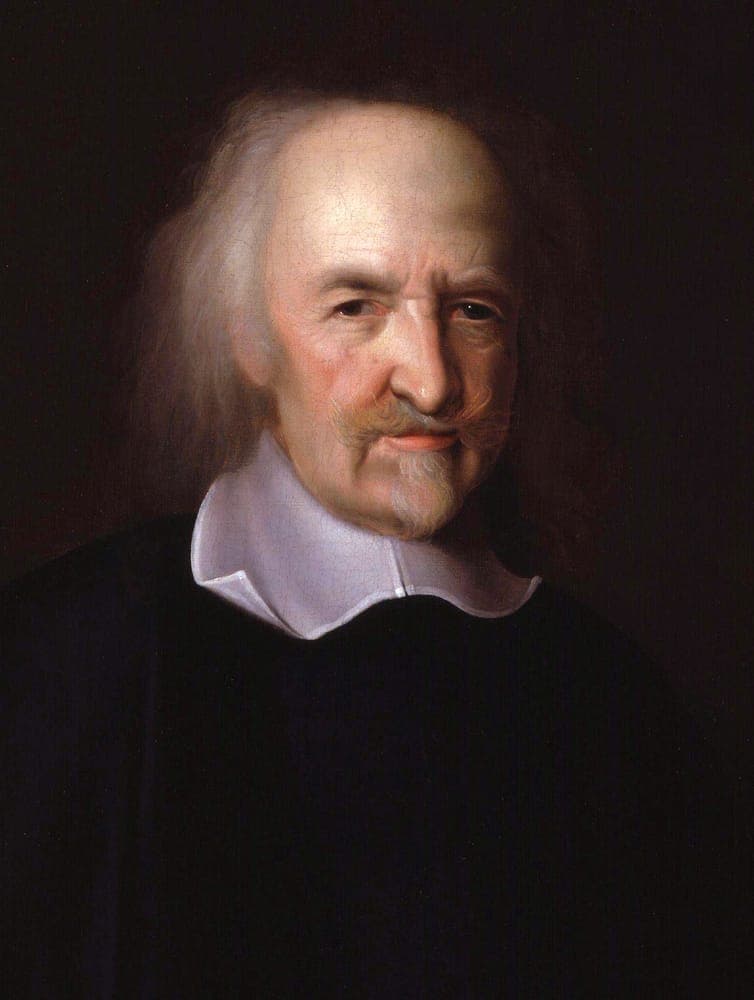
Author
Thomas Hobbes
- Lived
- Lived 1588 to 1679
- From
- From English
- Born in
- Born in Westport, Wiltshire
Born on 5 April 1588 in Westport, now part of Malmesbury in Wiltshire, Thomas Hobbes was delivered prematurely after his mother heard news of the approaching Spanish Armada; he later remarked that she gave birth to twins, himself and fear. His father, an unlettered vicar, abandoned the family after a fight with another clergyman outside his church, and the children were raised by their uncle Francis, a wealthy Malmesbury glover. Hobbes went up to Magdalen Hall, Oxford, at fourteen, graduated in 1608, and was hired as tutor and travelling companion to the Cavendish family, a connection that would last most of his life. On grand tours of Europe he met Galileo under house arrest in Florence in 1636 and joined the philosophical circle of Marin Mersenne in Paris. Fleeing the English Civil War, he spent eleven years in Paris, where he tutored the future Charles II in mathematics and wrote Leviathan (1651), the founding work of modern social contract theory, with its image of human life in the state of nature as solitary, poor, nasty, brutish, and short. His De Cive (1642), De Corpore (1655), and De Homine (1658) completed the system. Returning to England in 1652, he rejoined the Cavendish household and remained under their protection for the rest of his life. Accused of atheism throughout his later years, denied a burial place in his old college chapel, and publicly linked to the 1666 plague and the Great Fire of London by parliament as a chastisement for his impieties, he kept translating Homer into English verse into his eighties. He died at Hardwick Hall in Derbyshire on 4 December 1679, aged ninety-one.
At forty, in a gentleman's library, Hobbes found a copy of Euclid's Elements lying open to the Pythagorean theorem. 'By God,' he said, 'this is impossible!' He read the proof, then traced it backward through proposition after proposition until he reached the axioms, and fell in love with geometric certainty.
The first button needs the app on this device; the second gets it there.
In the canon
- Leviathan1651