
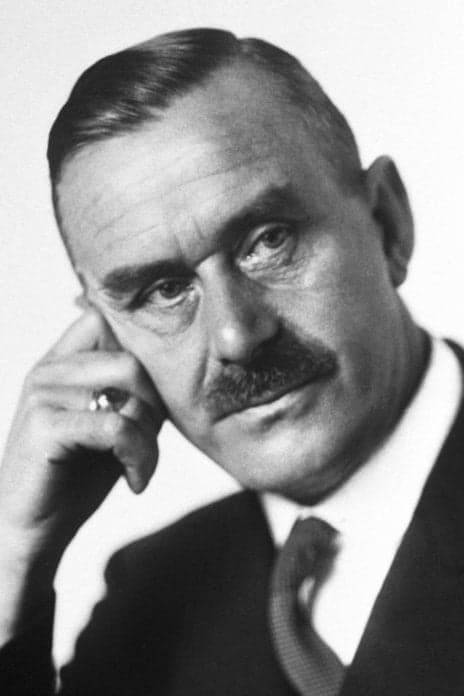
Author
Thomas Mann
- Lived
- Lived 1875 to 1955
- From
- From German
- Born in
- Born in Lübeck, Germany
Born Paul Thomas Mann on June 6, 1875, in Lübeck, a prosperous Hanseatic trading city on the Baltic coast of northern Germany, he was the second son of a wealthy grain merchant and senator. When his father died in 1891, the family firm was liquidated, and Mann moved to Munich, where he worked briefly for an insurance company before devoting himself to writing. Buddenbrooks (1901), begun when he was twenty-one, traced the decline of a mercantile family across four generations with an ironic precision that drew directly from the Mann family’s own history; it became a bestseller and would later be cited as the principal reason for his Nobel Prize in Literature (1929). Death in Venice (1912), a novella about an aging writer’s fatal obsession with a beautiful Polish boy in cholera-stricken Venice, remains one of the most perfectly constructed works of twentieth-century fiction. The Magic Mountain (1924), set in a Swiss tuberculosis sanatorium, expanded into a seven-hundred-page philosophical novel examining European civilization on the eve of its self-destruction. He married Katia Pringsheim in 1905; they had six children, three of whom , Erika, Klaus, and Golo , became significant writers themselves. When Hitler rose to power in 1933, Mann was abroad on a lecture tour and chose not to return, living first in Switzerland, then emigrating to the United States in 1939, where he settled in Pacific Palisades, California. He became an American citizen in 1944 and broadcast anti-Nazi radio addresses to Germany throughout the war. Doctor Faustus (1947) used the life of a fictional composer to allegorize Germany’s pact with barbarism. He returned to Switzerland in 1952 and died on August 12, 1955, in Zurich.
In the summer of 1950, at seventy-five, Mann fell for Franz Westermeier, a nineteen-year-old waiter at Zurich's Grand Hotel Dolder, and wrote in his diary, 'Once again this, once again love.' He later sealed his notebooks, marked not to be opened until twenty years after his death, and the world did not read the line until 1975.
The first button needs the app on this device; the second gets it there.
In the canon
- Buddenbrooks1901
- Tonio Kröger1903
- Royal Highness1909
- Death in Venice1912
- The Magic Mountain1924
- Mario and the Magician1929
- Joseph and His Brothers1933
- Doctor Faustus1947
- Confessions Of Felix Krull, Confidence Man1954