
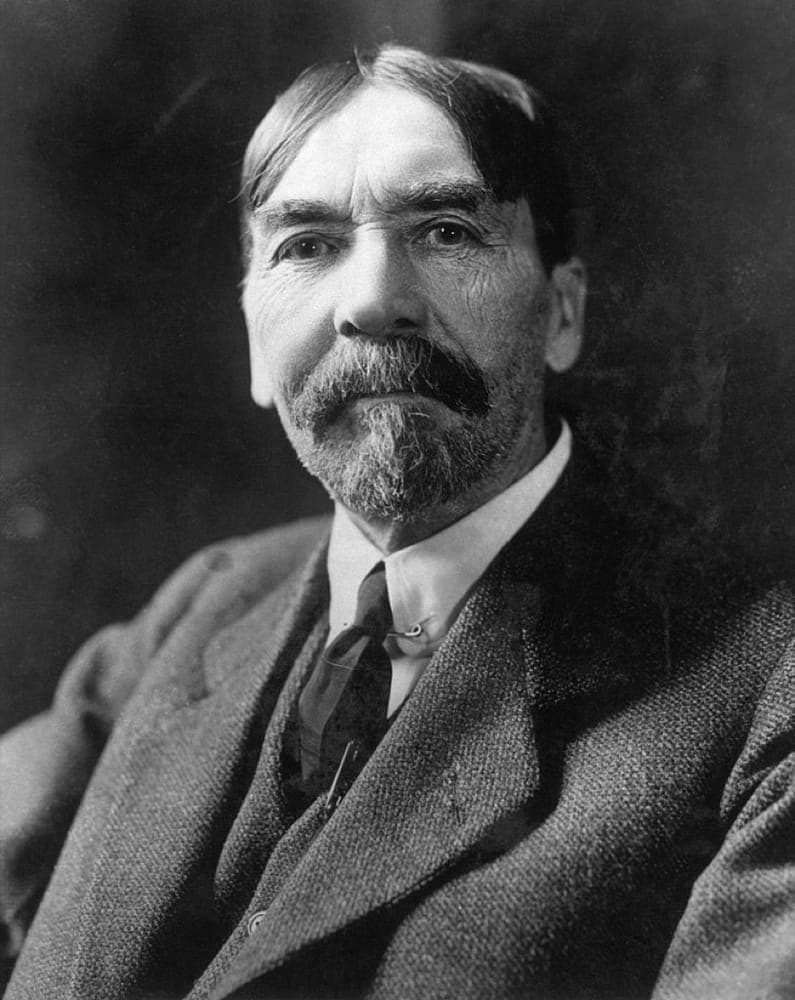
Author
Thorstein Veblen
- Lived
- Lived 1857 to 1929
- From
- From American
Born Thorstein Bunde Veblen on July 30, 1857, in Cato, Wisconsin, he was the sixth of twelve children of Norwegian immigrant farmers who spoke only Norwegian at home. The family soon moved to a farm in Minnesota, where the boy grew up an outsider to American life, fluent in the customs of the prairie but skeptical of its pieties. He entered Carleton College at seventeen, then studied at Johns Hopkins and Yale, where he earned a doctorate in philosophy in 1884. No teaching post followed for years; he returned to the farm and read voraciously until Cornell took him on, and Chicago after it. There, in 1899, he published The Theory of the Leisure Class, a study of how the wealthy display their standing through waste, coining the phrases conspicuous consumption and conspicuous leisure that entered the language. The Theory of Business Enterprise (1904) examined the conflict between industry and finance, and The Instinct of Workmanship (1914) traced the human urge to make things well. His prose was elaborate and deadpan, a satirist's instrument disguised as social science. His career was unsettled by affairs and academic suspicion; he drifted from Chicago to Stanford to Missouri, never holding a chair commensurate with his renown. He helped found the New School for Social Research in 1919. In his later years he turned to questions of war, peace, and the engineers he thought might run a rational economy. He died on August 3, 1929, in a cabin near Menlo Park, California, at seventy-two, having asked that no stone, marker, or memorial bear his name.
The first button needs the app on this device; the second gets it there.
In the canon
- The Theory of the Leisure Class1899