
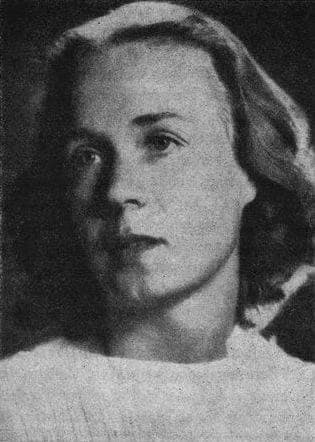
Author
Tove Ditlevsen
- Lived
- Lived 1917 to 1976
- From
- From Danish
- Born in
- Born in Copenhagen, Denmark
Born Tove Irma Margit Ditlevsen on December 14, 1917, in the working-class Vesterbro district of Copenhagen, the daughter of Ditlev Nielsen Ditlevsen, a stoker often out of work, and Kirstine Alfrida Mundus, who kept house, she grew up on Hedebygade with an older brother, Edvin, groomed for a trade while she was expected to marry one; her father told her plainly that girls do not become poets. She left school in her early teens and worked as a maid, a packer, and an office clerk while hiding poems she had been writing since the age of ten. At nineteen she published her debut poem in the youth journal Vild Hvede, edited by Viggo F. Møller, who became her first husband in 1940 in a marriage that lasted two years. Her debut collection, Pigesind (Girl Soul, 1939), and the later Blinkende Lygter (Flickering Lights, 1947), made her one of Denmark's best-loved poets. She married three more times: the teacher Ebbe Munk, with whom she had a daughter; the physician Carl Ryberg, whose Demerol injections during an abortion in 1945 began an opioid dependency that lasted decades and left her deaf in one ear; and the editor Victor Andreasen, who saw her through her worst years. Across twenty-nine books of poetry, stories, novels, and memoir, she wrote about girlhood, marriage, and addiction with a plainness that unsettled as much as it charmed, culminating in the autobiographical trilogy Barndom (Childhood, 1967), Ungdom (Youth, 1967), and Gift (Dependency, 1971). Repeatedly hospitalized for depression and drug dependency, and never granted the Danish Academy recognition she wanted, she took her own life with an overdose of sleeping pills on March 7, 1976, in Copenhagen, at fifty-eight. Untranslated into English until 2019, the trilogy has since been read as a founding text of confessional autofiction.
At nineteen, Ditlevsen published her debut poem in the youth journal Vild Hvede: a mother's lament over her dead infant son. She had never had a child. The poem grew instead from one evening with a young man leaving to fight in the Spanish Civil War, transposed into a grief she had only imagined.
The first button needs the app on this device; the second gets it there.
In the canon
- Childhood1967
- Youth1967
- Dependency1971