
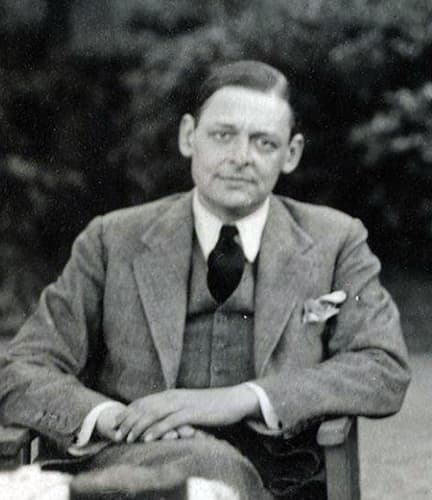
Author
T.S. Eliot
- Lived
- Lived 1888 to 1965
- From
- From American-British
- Born in
- Born in St. Louis, Missouri
Born on September 26, 1888, in St. Louis, Missouri, into a distinguished Boston Brahmin family, his grandfather had founded Washington University, Thomas Stearns Eliot studied philosophy at Harvard, the Sorbonne, and Merton College, Oxford, before settling in England in 1914. He never returned to America to live. "The Love Song of J. Alfred Prufrock" (1915), written when he was twenty-two, announced a new kind of poetry, ironic, allusive, formally daring, that bewildered and electrified the literary world. He married Vivienne Haigh-Wood in 1915, a union that proved disastrous; her mental illness and their mutual misery shadowed his work for decades. The Waste Land (1922), edited by Ezra Pound into its final compressed form, became the defining poem of modernist despair. He joined the publishing house Faber and Faber in 1925, where as an editor he championed Auden, Pound, and Djuna Barnes. His conversion to Anglo-Catholicism in 1927, the same year he became a British citizen, surprised many and redirected his poetry toward the spiritual meditations of Ash Wednesday (1930) and Four Quartets (1943), the latter widely regarded as his masterpiece. His verse dramas, including Murder in the Cathedral (1935), brought poetry back to the stage. He won the Nobel Prize in Literature in 1948. After Vivienne's death in a mental hospital in 1947, he married Valerie Fletcher in 1957 and experienced a decade of quiet happiness. He died on January 4, 1965, in London, and his ashes were interred at St Michael and All Angels Church in East Coker, the Somerset village from which his ancestors had emigrated to America.
In 1922, Ezra Pound quietly organized Bel Esprit, a subscription to free Eliot from his desk at Lloyds Bank. A newspaper broke the story and mocked it, and Eliot, mortified and fearing for his job, demanded a retraction. He kept the desk for three more years, valuing its steady pension.
The first button needs the app on this device; the second gets it there.
In the canon, 37 works
- The Love Song of J. Alfred Prufrock1915
- Portrait of a Lady1917
- Preludes1917
- Rhapsody on a Windy Night1917
- Morning at the Window1917
- The Boston Evening Transcript1917
- Aunt Helen1917
- Cousin Nancy1917
- Mr. Apollinax1917
- La Figlia che Piange1917
- Tradition and the Individual Talent1919
- The Waste Land1922