
Author
Ursula K. Le Guin
- Lived
- Lived 1929 to 2018
- From
- From American
- Born in
- Born in Berkeley, California
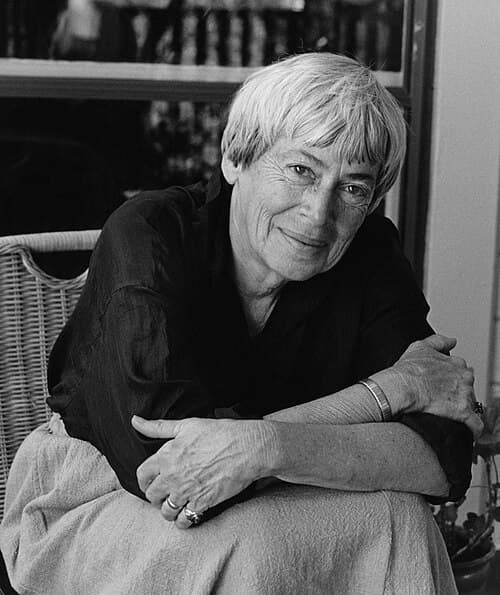
Born Ursula Kroeber on October 21, 1929, in Berkeley, California, the daughter of the distinguished anthropologist Alfred Louis Kroeber and the writer Theodora Kroeber , whose book Ishi in Two Worlds (1961) told the story of the last surviving member of the Yahi people , Le Guin grew up in an intellectually rich household where Native American scholars, scientists, and writers were frequent guests. She earned a bachelor’s degree from Radcliffe College in 1951 and a master’s in French from Columbia University in 1952, then began doctoral studies on a Fulbright fellowship in Paris, where she met and married the historian Charles Le Guin in 1953. She began publishing science fiction and fantasy in the late 1950s, and within a decade had produced two of the genre’s most consequential works: A Wizard of Earthsea (1968), which reimagined the fantasy quest as a confrontation with the shadow-self, and The Left Hand of Darkness (1969), a novel set on a planet whose inhabitants have no fixed gender, which won both the Hugo and Nebula Awards and permanently expanded the possibilities of speculative fiction. The Dispossessed (1974), subtitled “An Ambiguous Utopia,” explored anarchist political philosophy through the story of a physicist caught between two worlds. Her work drew deeply on Taoism, anthropology, and feminist thought, and she became one of the most honored writers in American literature, winning six Hugo Awards, six Nebula Awards, and the National Book Foundation Medal for Distinguished Contribution to American Letters in 2014. She died on January 22, 2018, in Portland, Oregon, at the age of eighty-eight.
In 1953, sailing from New York to Southampton on a Fulbright crossing, Ursula Kroeber found herself seated among strangers at dinner. Only she answered when a soft-spoken historian named Charles Le Guin asked if anyone wanted another drink. They married in Paris before the year was out.
The first button needs the app on this device; the second gets it there.
In the canon
- A Wizard Of Earthsea1968
- The Left Hand Of Darkness1969
- The Tombs Of Atuan1971
- The Lathe of Heaven1971
- The Farthest Shore1972
- The Word for World Is Forest1972
- The Ones Who Walk Away from Omelas1973
- The Dispossessed1974
- Tehanu1990