
Author
Valmiki
- Lived
- Lived 500 BCE to 400 BCE
- From
- From Indian
- Born in
- Born in Northern India
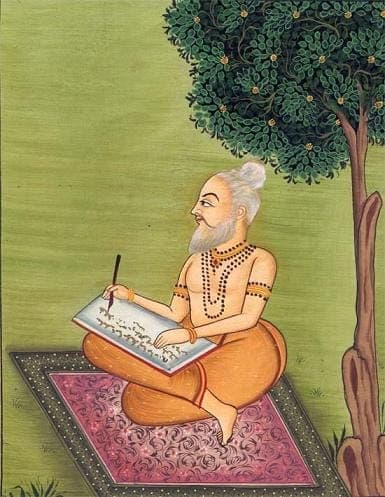
Born by tradition into a Brahmin family in ancient north India, in a period scholars estimate between the seventh and fourth centuries BCE, Valmiki passes into history only through the poem he made and the legends that grew around him. The strongest legend has him a robber on the forest road, named Ratnakara, waylaying travellers to feed his family until the wandering sage Narada stopped him and asked whether his wife and children would share the sin he gathered for their sake. They would not. Stricken, he sat down to meditate on the name of Rama, and so long did he sit motionless that an anthill, a valmika, rose around him. When the sages returned and found him still alive inside it, they called him Valmiki, the one born of the anthill. The poem itself opens with a second hinge moment. Walking beside the Tamasa river he saw a hunter shoot down a male krauncha bird as it sang to its mate, and his cry of grief and rage came out as Sanskrit's first shloka, the metre in which he then composed the whole Ramayana. Twenty-four thousand verses across seven cantos, in roughly four hundred and eighty thousand words, tell the story of Rama, prince of Ayodhya, his exile, the abduction of his wife Sita by the demon king Ravana of Lanka, and the great war for her recovery. In the closing book it is Valmiki himself who shelters Sita after Rama banishes her and teaches the poem to her twin sons Lava and Kusha. Hindu tradition reveres him as the Adi Kavi, the first poet, the well from which Indian literature flows.
Bathing in the Tamasa river, Valmiki watched a hunter's arrow drop a male krauncha bird from the sky while its mate circled, calling. His grief broke into verse without his willing it, a curse against the hunter cast in perfect meter. Sanskrit had never produced that rhythm before. He had, without meaning to, invented the shloka.
The first button needs the app on this device; the second gets it there.
In the canon
- Rama the Steadfast400 BCE
- Ramayana200 BCE