
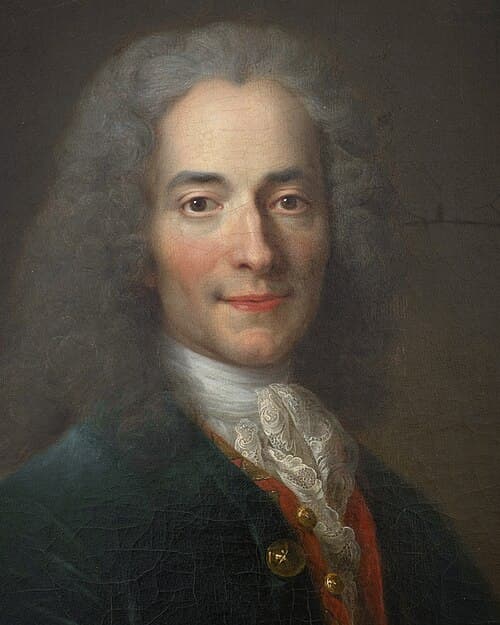
Author
Voltaire
- Lived
- Lived 1694 to 1778
- From
- From French
- Born in
- Born in Paris, France
Born François-Marie Arouet on November 21, 1694, in Paris, the youngest of five children in a prosperous bourgeois family , his father was a notary and minor treasury official , the writer who would become Voltaire was educated by Jesuits at the Collège Louis-le-Grand, where he developed the classical learning and savage wit that would make him the most dangerous pen in Europe. He adopted the name Voltaire around 1718, possibly an anagram of “Arouet l.j.” (le jeune). His satirical verses mocking the Regent earned him eleven months in the Bastille, where he wrote his first tragedy, Œdipe (1718), and began the epic poem La Henriade. A second imprisonment in the Bastille in 1726, following a dispute with the Chevalier de Rohan, led to exile in England, where he spent nearly three years absorbing the works of Locke, Newton, and Shakespeare. The resulting Lettres philosophiques (1734) praised English tolerance and implicitly condemned French absolutism, causing a scandal that forced him to flee Paris again. He produced works in virtually every literary form , plays, poems, histories, philosophical treatises, and more than twenty thousand letters , while waging lifelong campaigns against religious intolerance, judicial torture, and censorship. Candide (1759), a satirical novella demolishing Leibnizian optimism through a cascade of disasters visited upon its naïve hero, remains his masterpiece and one of the most widely read works of the Enlightenment. He spent his final decades at Ferney, near the Swiss border, where he could flee French jurisdiction if necessary. He returned triumphantly to Paris in 1778 for the premiere of his play Irène, and died there on May 30, 1778, at the age of eighty-three.
In 1729, Voltaire and the mathematician La Condamine spotted a flaw in the French royal lottery: a cheap bond ticket carried the same odds as an expensive one. They bought up the cheap tickets by the hundred, month after month, until the government shut the scheme down. Voltaire's winnings, roughly half a million livres, made him wealthy for life.
The first button needs the app on this device; the second gets it there.
In the canon
- Letter I: On the Quakers1733
- Letters on England1734
- Zadig1747
- Correspondence1751
- Micromégas1752
- Candide1759
- The Maid of Orleans1762