
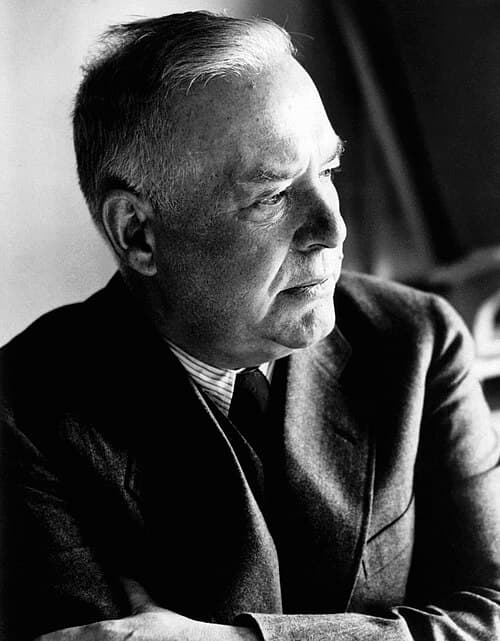
Author
Wallace Stevens
- Lived
- Lived 1879 to 1955
- From
- From American
- Born in
- Born in Reading, Pennsylvania
Born on October 2, 1879, in Reading, Pennsylvania, the son of a prosperous lawyer and schoolteacher, Wallace Stevens attended Harvard for three years, where he edited the Advocate and absorbed the aestheticism that would color all his work. He took a law degree from New York Law School in 1904, practiced briefly in New York, and in 1916 joined the Hartford Accident and Indemnity Company in Connecticut, where he would rise to vice president and remain until his death. The double life became his signature: by day an insurance executive dealing in surety bonds, by night and on his famous two-mile walks to work , composing lines to the rhythm of his stride , he was among the most ambitious poets of the century. Harmonium (1923), his first book, sold fewer than a hundred copies but contained “Sunday Morning,” “The Emperor of Ice-Cream,” and “Thirteen Ways of Looking at a Blackbird,” poems that reimagined what English verse could do with sound, color, and philosophical argument. He published almost nothing for a decade, then reemerged with Ideas of Order (1935) and The Man with the Blue Guitar (1937). In Key West in 1936, drunk at a party, he took a swing at Ernest Hemingway and broke his own hand on the novelist’s jaw. Notes Toward a Supreme Fiction (1942) and The Auroras of Autumn (1950) deepened his central inquiry: whether poetry could replace religion as a source of meaning. His Collected Poems (1954) won the Pulitzer Prize. Stevens died of stomach cancer on August 2, 1955, in Hartford, at seventy-five, having never held a teaching post or given a public reading in a university.
In the late 1940s, Stevens bought a still life by the French painter Pierre Tal Coat, choosing it entirely from his Paris dealer's written description. He never saw the canvas or met the painter. Working only from that secondhand account of bottles and pots, he wrote 'Angel Surrounded by Paysans,' turning someone else's kitchen table into peasants.
The first button needs the app on this device; the second gets it there.
In the canon
- The Emperor of Ice-Cream1922
- The Snow Man1923
- Thirteen Ways of Looking at a Blackbird1923
- Sunday Morning1923
- Peter Quince at the Clavier1923
- Anecdote of the Jar1923
- Domination of Black1923
- The Idea of Order at Key West1935
- The Man with the Blue Guitar1937
- Notes Toward a Supreme Fiction1942
- Of Modern Poetry1942
- The Palm At The End Of The Mind1971