
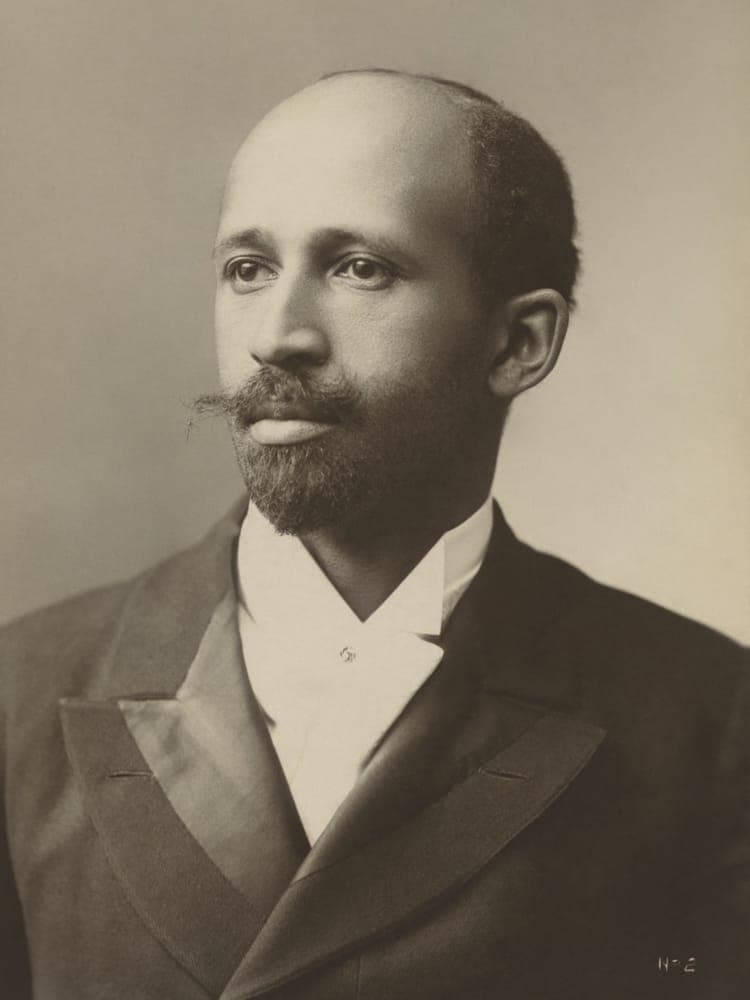
Author
W.E.B. Du Bois
- Lived
- Lived 1868 to 1963
- From
- From American
- Born in
- Born in Great Barrington, Massachusetts
Born William Edward Burghardt Du Bois on February 23, 1868, in Great Barrington, Massachusetts, he was raised by his mother, Mary Silvina Burghardt, in a small New England town where his family had lived for generations. A gifted student, he attended Fisk University in Nashville, where he first encountered the segregated South and taught in rural Tennessee schools during the summers, then went on to Harvard, becoming in 1895 the first African American to earn a doctorate there. He studied in Berlin as well, and his Harvard dissertation, The Suppression of the African Slave-Trade to the United States of America (1896), launched a career that joined scholarship to advocacy. The Philadelphia Negro (1899) was a pioneering sociological survey of an urban Black community. Then came The Souls of Black Folk (1903), fourteen essays opening with the line that the problem of the twentieth century is the problem of the color line, a book that broke with Booker T. Washington's accommodationism and gave currency to the idea of double consciousness. In 1909 he helped found the National Association for the Advancement of Colored People, editing its magazine The Crisis for nearly a quarter century and shaping its national voice. His later books include Black Reconstruction in America (1935) and the autobiography Dusk of Dawn (1940). Increasingly drawn to socialism and Pan-Africanism, he joined the Communist Party in 1961 and, disillusioned with his country, emigrated to Ghana at the invitation of Kwame Nkrumah, taking citizenship there. He died in Accra on August 27, 1963, at the age of ninety-five, on the eve of the March on Washington, where the news of his passing was announced to the assembled crowd.
In a wee wooden schoolhouse in the hills of New England, boys and girls traded visiting cards, until a new girl refused his with a single dismissive glance. In that instant, young Du Bois understood he was different, shut out from the others' world by what he later named a veil.
The first button needs the app on this device; the second gets it there.
In the canon
- Of Our Spiritual Strivings1903
- The Souls of Black Folk1903
- Black Reconstruction In America1935