
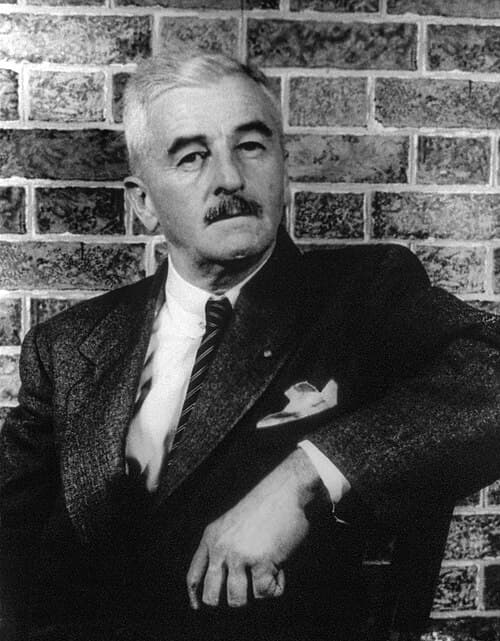
Author
William Faulkner
- Lived
- Lived 1897 to 1962
- From
- From American
- Born in
- Born in New Albany, Mississippi
Born William Cuthbert Falkner on September 25, 1897, in New Albany, Mississippi , the “u” in the surname was added later, reportedly due to a printer’s error that he chose to keep. He grew up in Oxford, Mississippi, where his father ran a livery stable and later served as business manager at the University of Mississippi. A reluctant student who never finished high school, Faulkner briefly joined the Royal Air Force in Canada during World War I but never saw combat. He returned to Oxford and began writing, publishing the novel Soldiers’ Pay (1926) before creating, with Sartoris (1929), the fictional Yoknapatawpha County , modeled on Lafayette County and its seat of Oxford , which he would populate across more than a dozen novels. Between 1929 and 1936 he produced the works that secured his place among the supreme novelists of the century: The Sound and the Fury (1929), with its four narrators including the intellectually disabled Benjy; As I Lay Dying (1930), reportedly written in six weeks while working the night shift at a power plant; Light in August (1932); and Absalom, Absalom! (1936), a labyrinthine saga of Southern guilt and obsession. His innovations in stream of consciousness, fractured chronology, and multiple perspective transformed the possibilities of fiction. He spent stretches in Hollywood as a screenwriter to pay the bills. The Nobel Prize in Literature came in 1949; his acceptance speech in Stockholm, declaring that man “will not merely endure: he will prevail,” became one of the most quoted statements of the twentieth century. On June 17, 1962, Faulkner was thrown from his horse, Stonewall, near his home at Rowan Oak. The injury worsened, and on July 6, 1962, he died of a heart attack at Wright’s Sanitarium in Byhalia, Mississippi. He was sixty-four.
As postmaster at the University of Mississippi, Faulkner read novels on duty, played cards with friends, and threw undelivered mail in a garbage can by the door. An inspector's report caught up with him in 1924, and he resigned first, refusing, as he wrote, to stay at the beck and call of every scoundrel with two cents for a postage stamp.
The first button needs the app on this device; the second gets it there.
In the canon, 27 works
- The Sound and the Fury1929
- Sartoris1929
- As I Lay Dying1930
- A Rose for Emily1930
- Red Leaves1930
- Sanctuary1931
- Dry September1931
- That Evening Sun1931
- Spotted Horses1931
- Light in August1932
- Wash1934
- Pylon1935